William "Bill" Rakocy 1947 Oil on Panel — Town on Mactan Island View Watchlist >
Seller Accepts Credit Cards
Payment and pickup instructions will be available on your invoice (under "My Account") at the conclusion of this auction.
Lot # F763
System ID # 29430928
Start Date
End Date
0 Watching
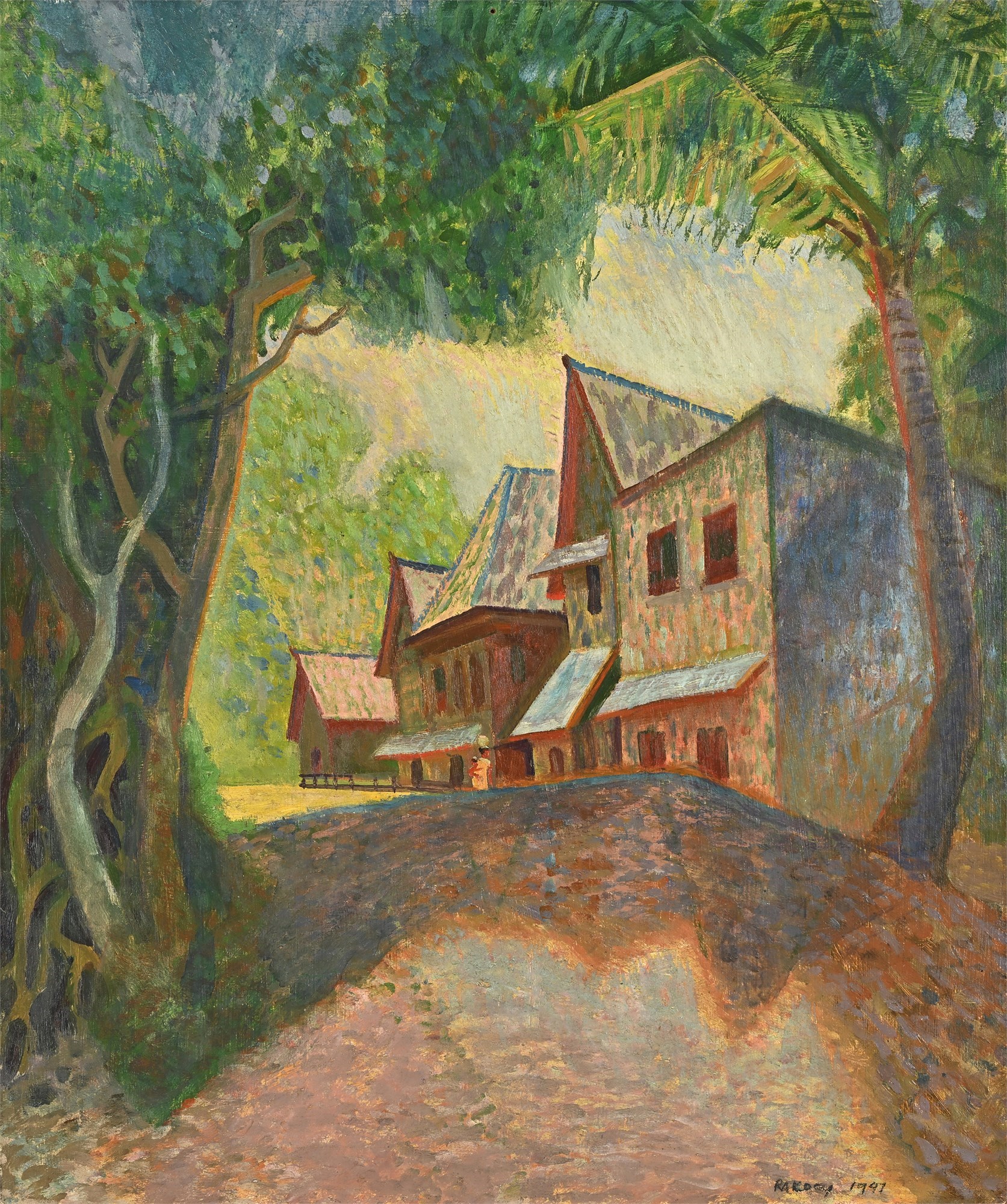
William "Bill" Rakocy 1947 Oil on Panel — Town on Mactan Island, Philippines, Village of Opón
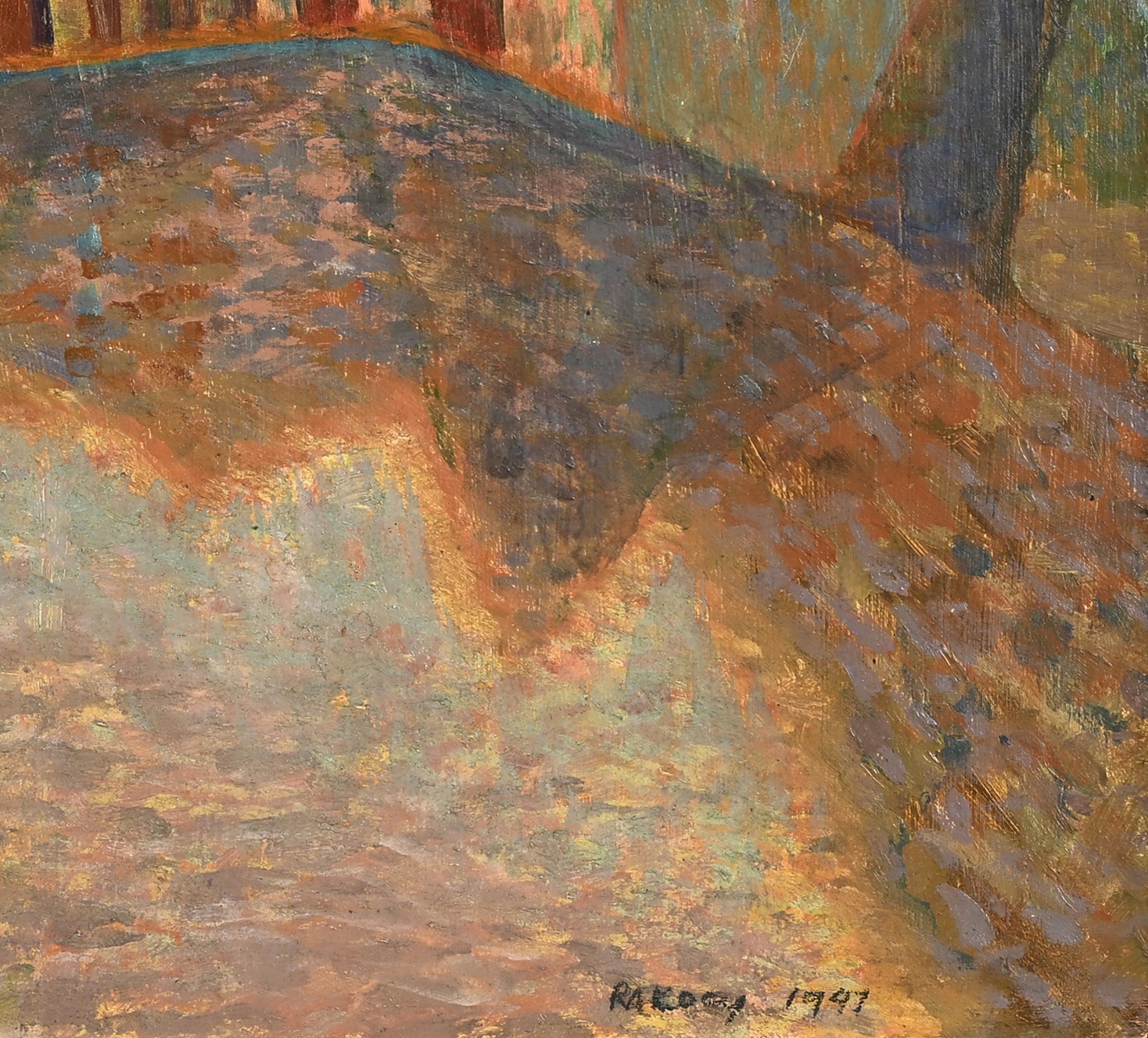
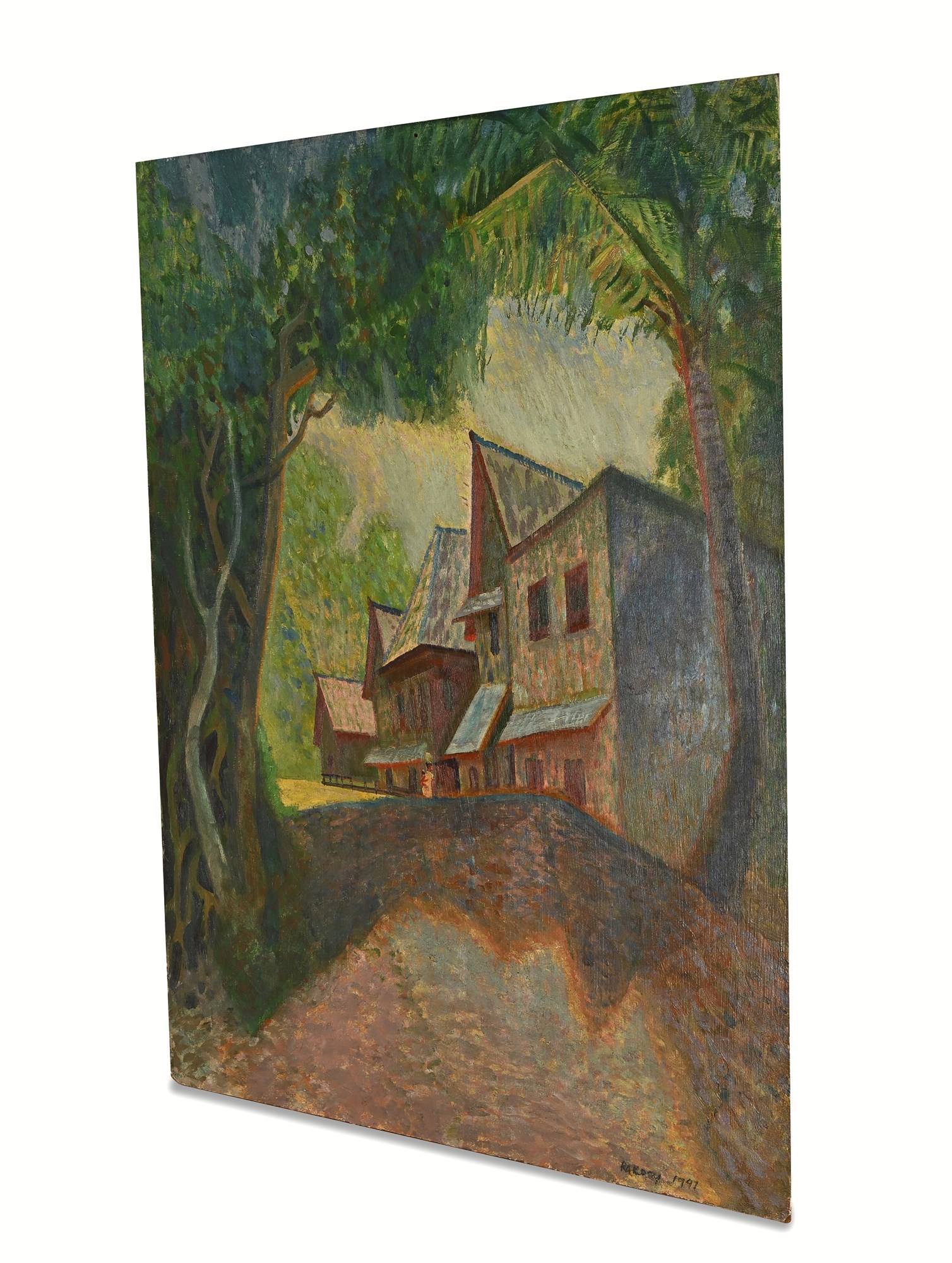
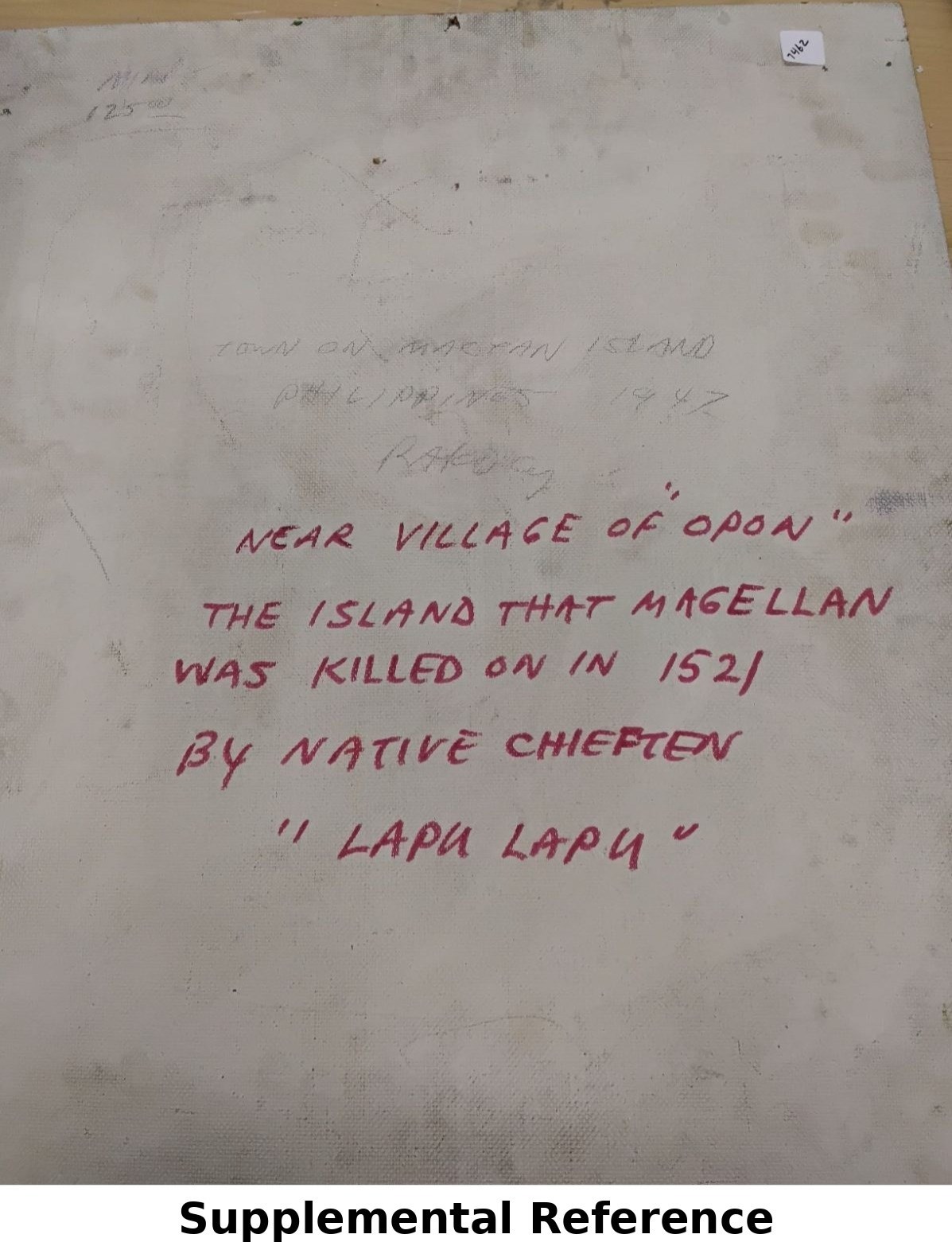
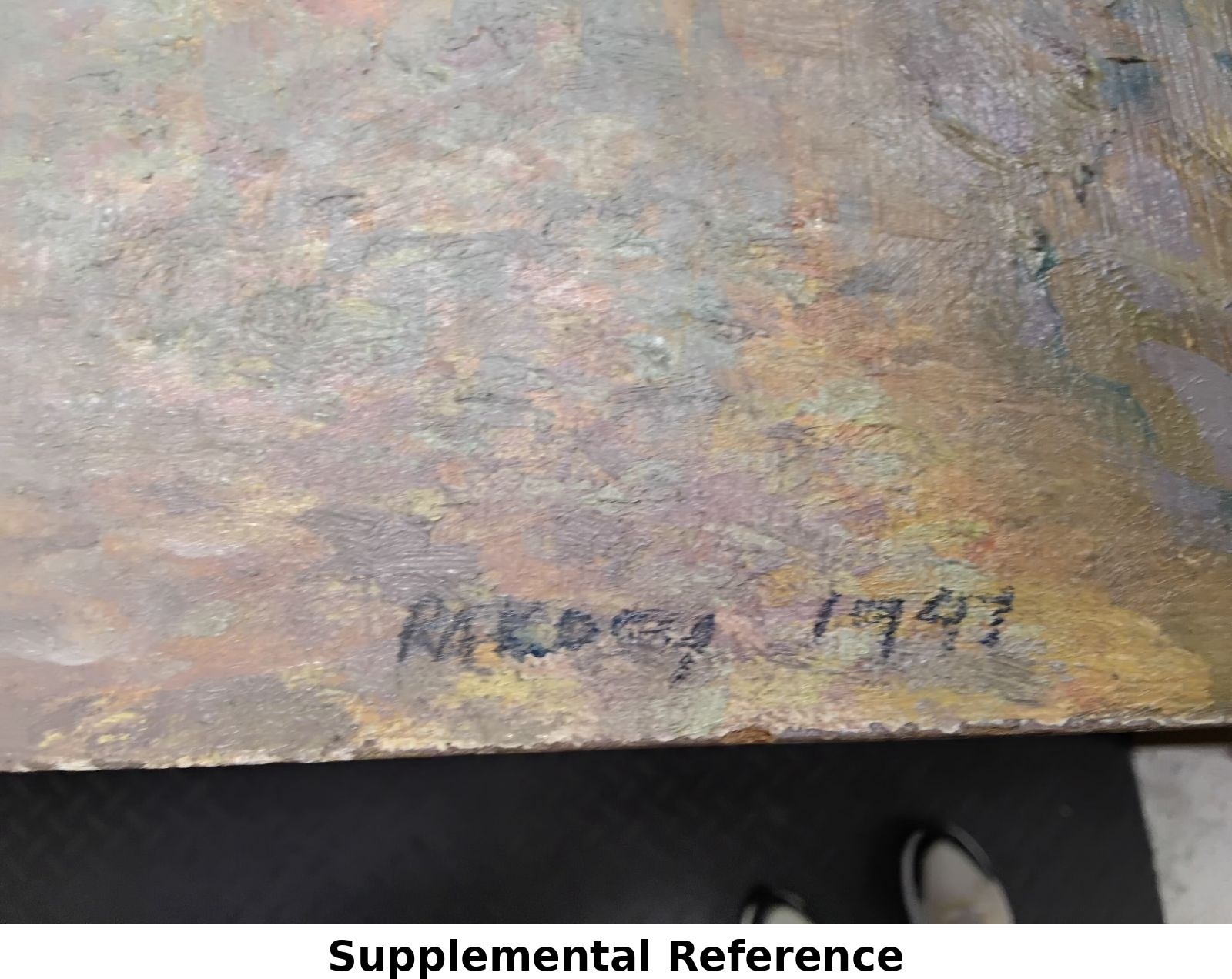
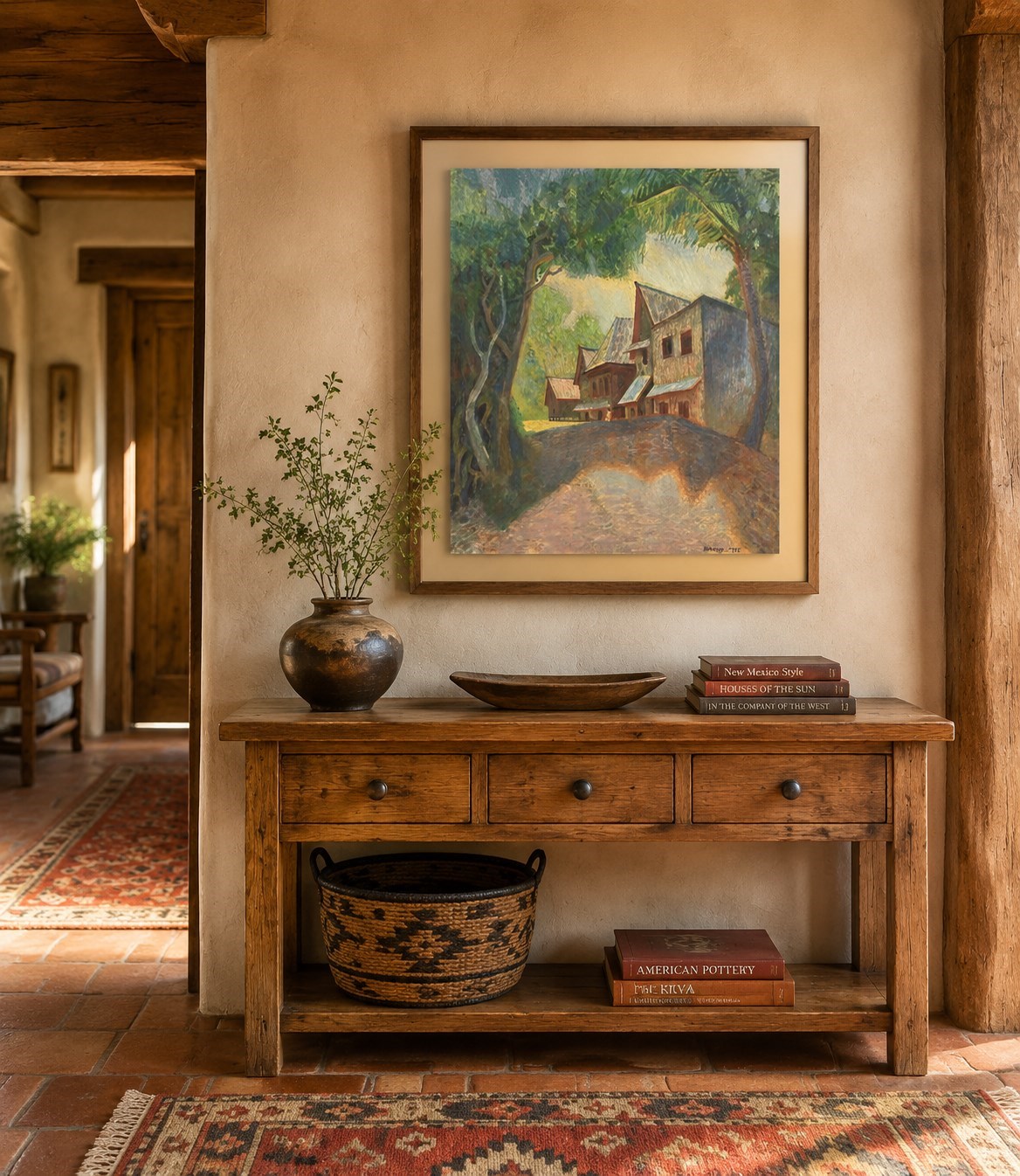
A clay-red road curves uphill through broken ochre and violet shadow, drawing the eye toward a cluster of steep-gabled timber buildings half-swallowed by tropical canopy. A single figure in light dress stands at a doorway — the only human presence in a composition otherwise given over to architecture, shadow, and the kind of dense green light that belongs only to islands close to the equator. William "Bill" Rakocy signed and dated the work lower right, "Rakocy 1947," and then turned the panel over and wrote what he was looking at — fully, in his own hand: "Town on Mactan Island, Philippines, 1947 — Near Village of 'Opon' — the island that Magellan was killed on in 1521 by native chieftain 'Lapu Lapu.'" He didn't just paint the place. He documented why it mattered.
The handling is assured and post-impressionist — short, dabbed brushwork building up a high-keyed palette of forest green, terracotta, and slate blue, with the building planes simplified toward near-architectural geometry. It reads as a working travel painting made on location: the kind of canvas a disciplined artist carries precisely because he intends to use it. By 1947, Mactan Island had already lived through two world-historical moments — Magellan's death and the Japanese occupation of the Philippines — and Rakocy had been present for the American end of the second one. His quiet village scene carries a particular weight when set against both the Spanish colonial history his inscription cites and the Pacific war that would have put him there in the first place.
About the Artist
William "Bill" Rakocy (1924–2008) was born and raised in the El Paso–Las Cruces borderland and became one of the region's most versatile mid-century artists — a painter, printmaker, and illustrator whose career was shaped decisively by his U.S. military service during World War II. Stationed across the Pacific theater, Rakocy painted and sketched as he traveled: the Philippines, Japan, and the wider Pacific island chain left a substantial mark on his work from the late 1940s. Back in El Paso, he became a fixture of the local art community, exhibiting regularly with the El Paso Art Association and building a regional reputation for work that combined technical facility with an illustrator's eye for place and narrative. His work appears in Borderland collections on both sides of the Rio Grande, and his Pacific-period paintings — annotated on the verso with place names, dates, and historical commentary in his own hand — stand as a distinct and historically grounded body of work. This is exactly that kind of painting.
Significance & Rarity
Mactan Island is one of the most charged locations in the history of the Pacific. On April 27, 1521, the Visayan chieftain Lapu-Lapu led his warriors against Ferdinand Magellan's landing force and killed the explorer in the shallows — ending the first circumnavigation of the earth before its captain could complete it. Lapu-Lapu is honored today as the first Filipino to resist European conquest, and his name is given to the island's modern city. Rakocy's inscription shows he understood exactly where he was standing and why it mattered. The village of Opón — now Lapu-Lapu City — sits on Mactan just across the strait from Cebu. When Rakocy painted this road, the island had also just emerged from Japanese occupation during the Second World War; the Philippines had declared independence from the United States only the year before, in 1946. A 1947 oil-on-panel by a named El Paso artist, painted on location in the Philippines in the immediate postwar years, with a fully inscribed verso identifying the subject, the date, and the layered historical context in the artist's own hand — this is a primary-source object. It belongs at the intersection of art history, Pacific War history, and the long, complicated story of a place that has been contested, colonized, liberated, and claimed by many flags over five hundred years.
CONDITION
Good overall. Unframed canvas panel with light edge wear and minor handling marks to the perimeter; paint surface is stable with no observed lifting or active losses. Signature and date are legible at lower right; verso inscription is clear and complete.
DIMENSIONS / SPECIFICATIONS
- Overall: 26 1/4" H × 21 3/4" W
- Medium: Oil on canvas panel
- Signed and dated lower right: "Rakocy 1947"
- Verso inscribed: "Town on Mactan Island, Philippines, 1947 / Rakocy / Near Village of 'Opon' — the island that Magellan was killed on in 1521 by native chieftain 'Lapu Lapu'"
- Unframed