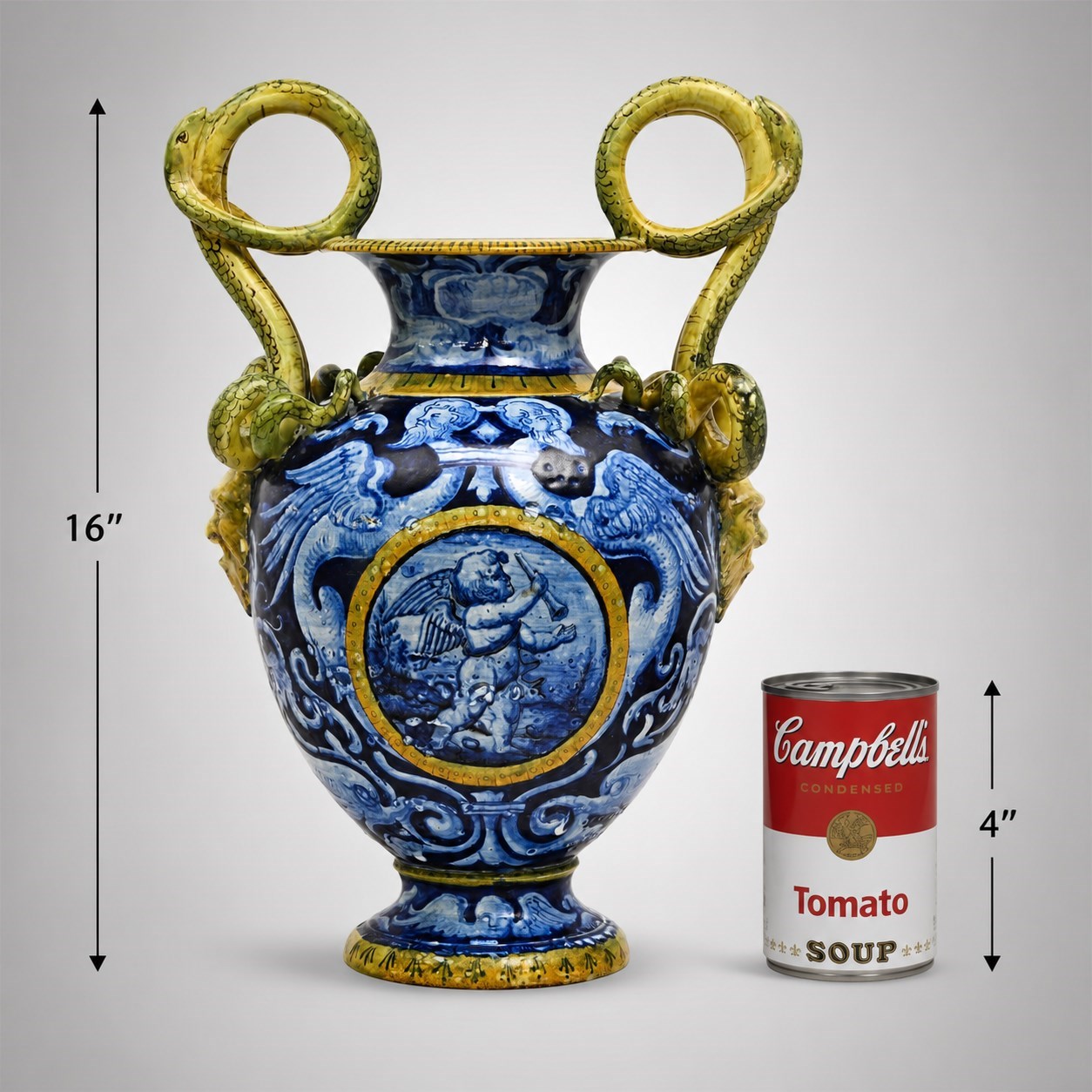
Cantagalli Maiolica Serpent-Handle Amphora, Florentine Renaissance Revival View Watchlist >
Seller Accepts Credit Cards
Payment and pickup instructions will be available on your invoice (under "My Account") at the conclusion of this auction.
Lot # F581
System ID # 29306143
Start Date
End Date
3 Watching
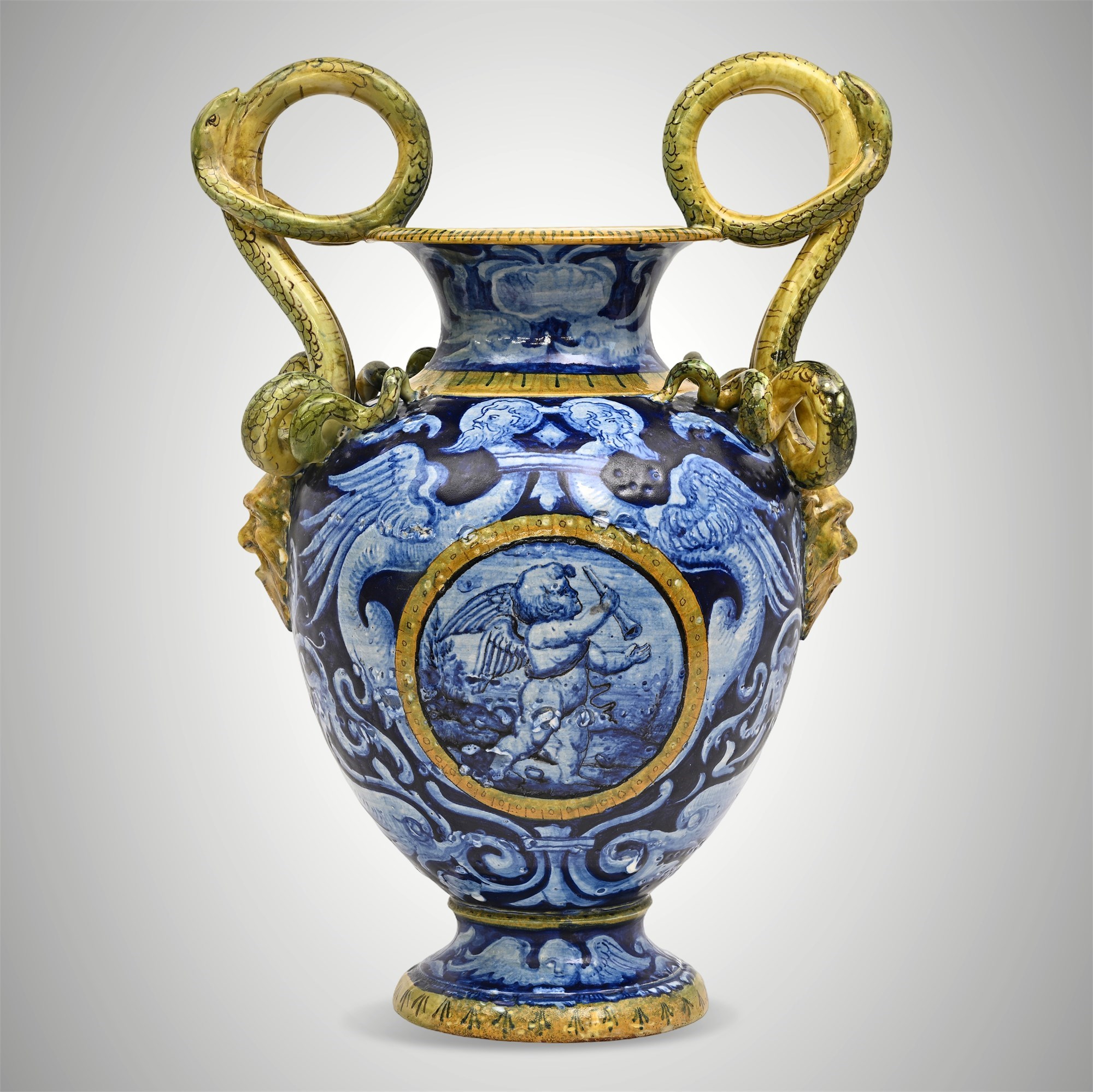
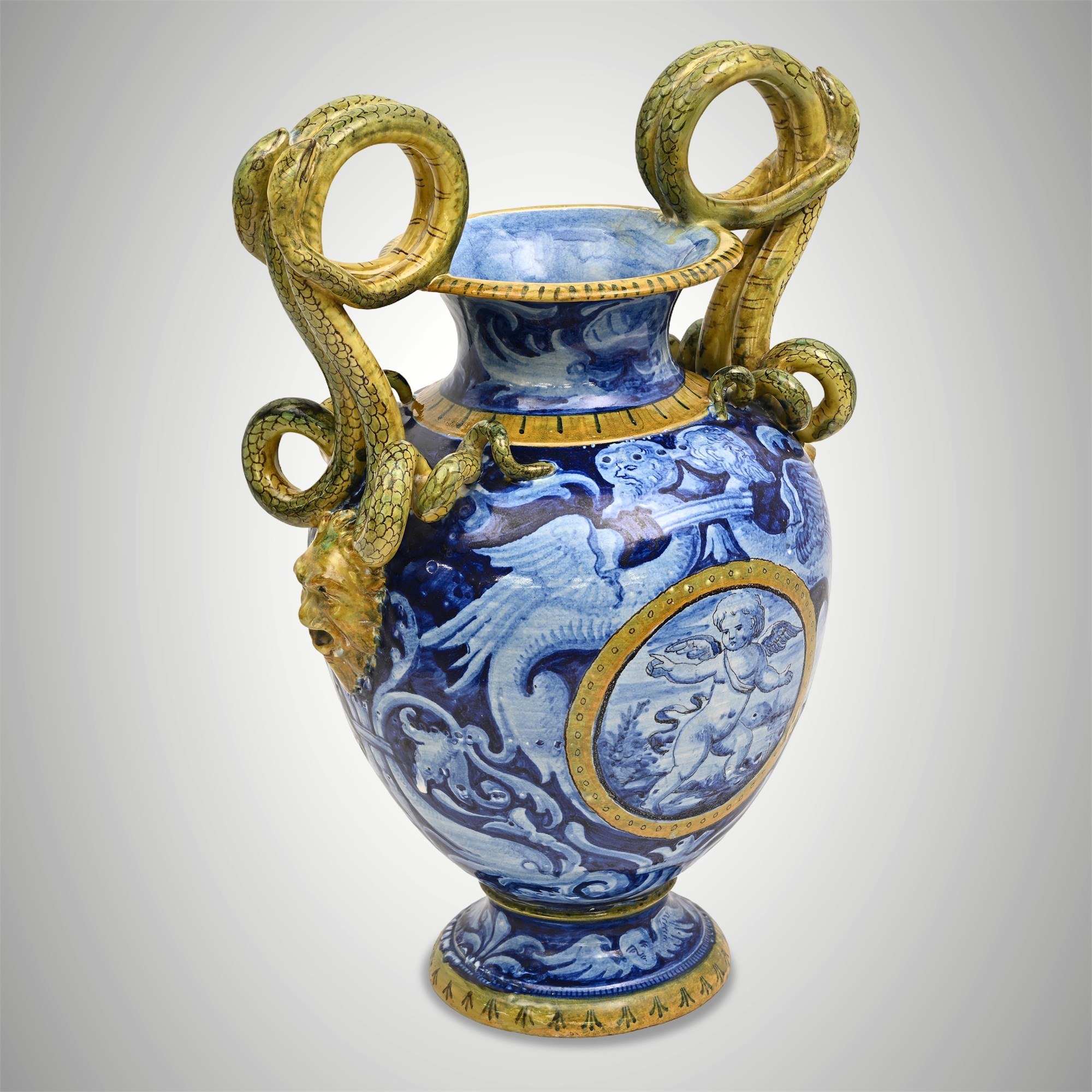
Cantagalli Maiolica Serpent-Handle Amphora, Florentine Renaissance Revival, c. 1880s–1900s
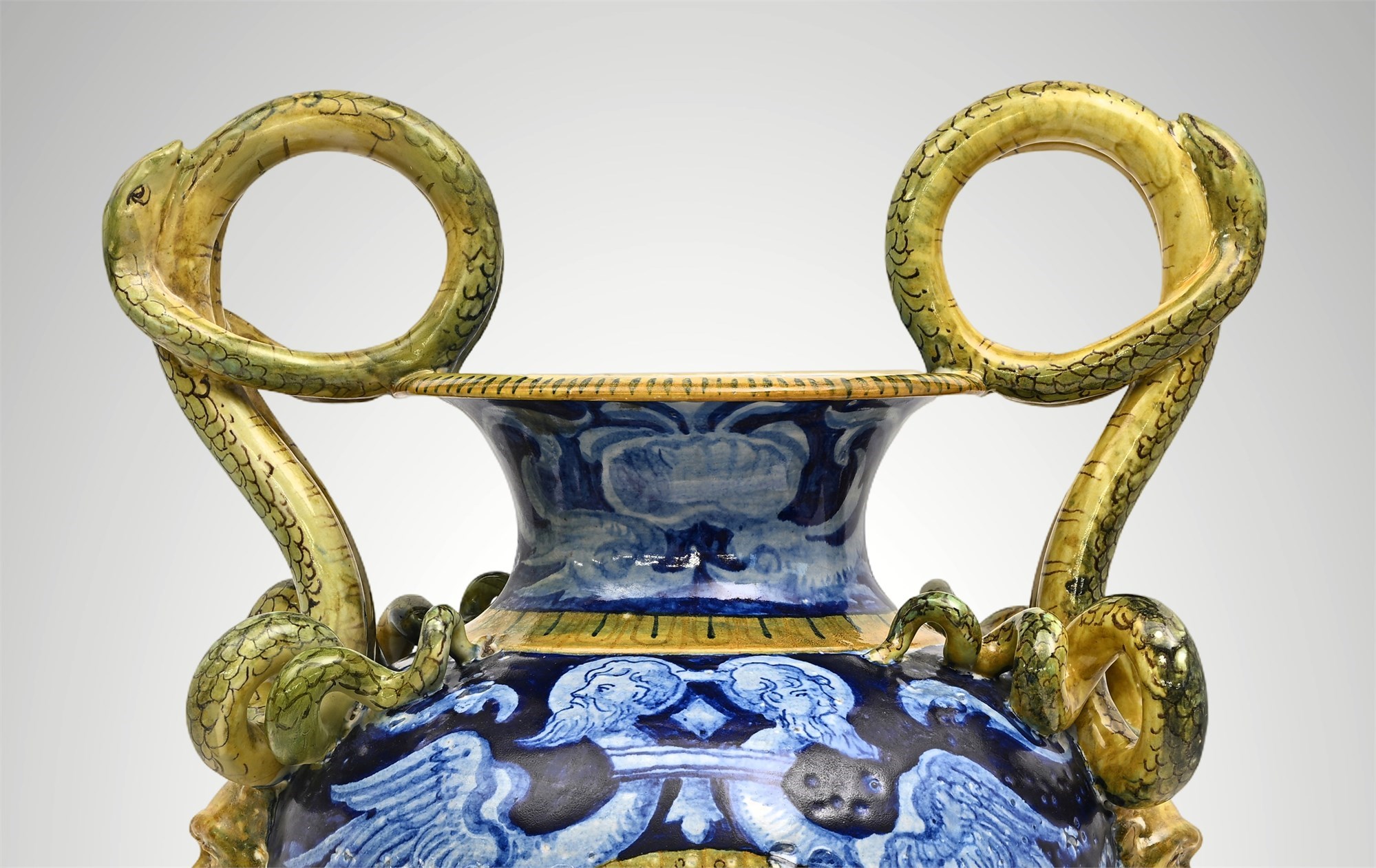
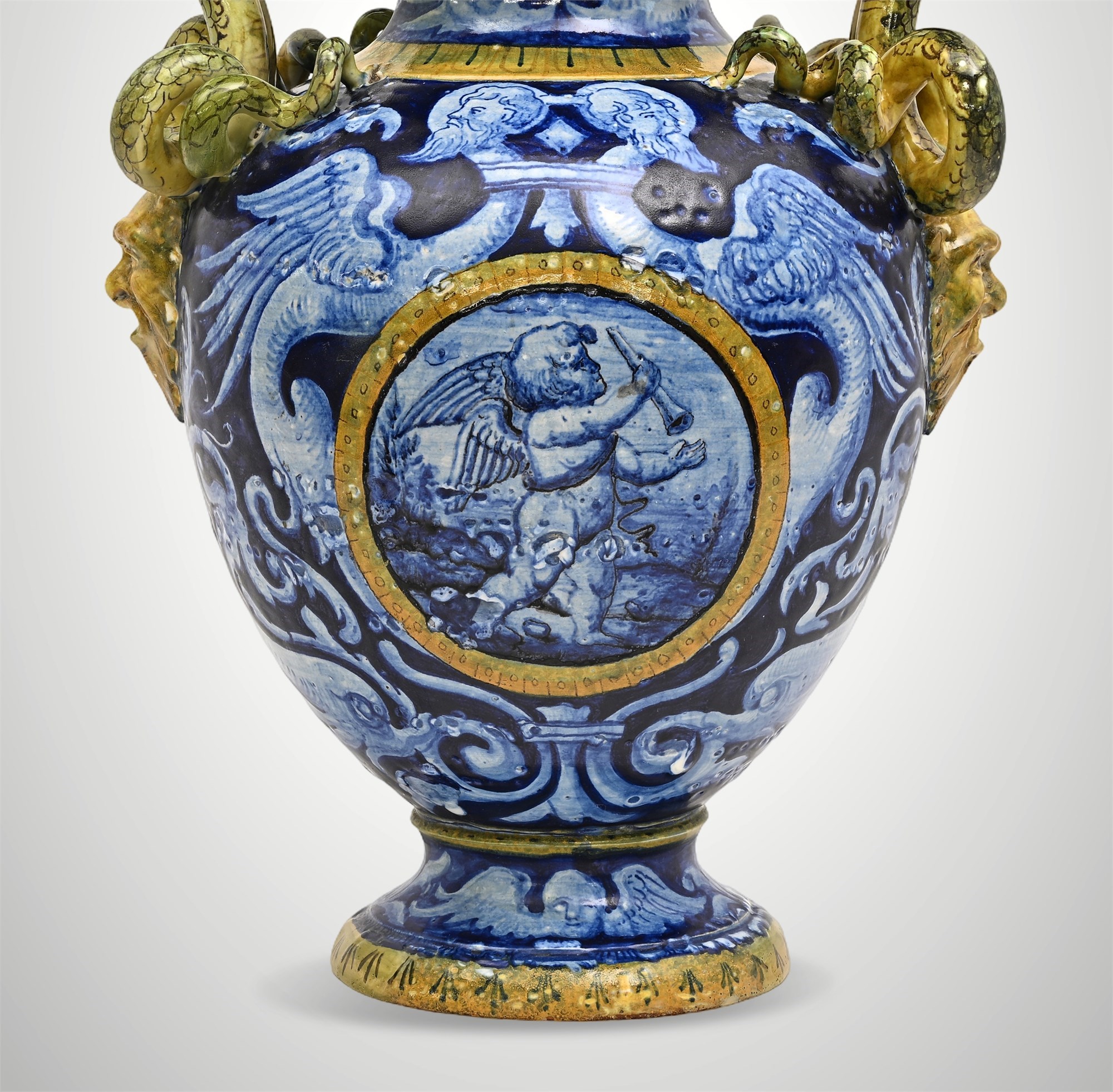
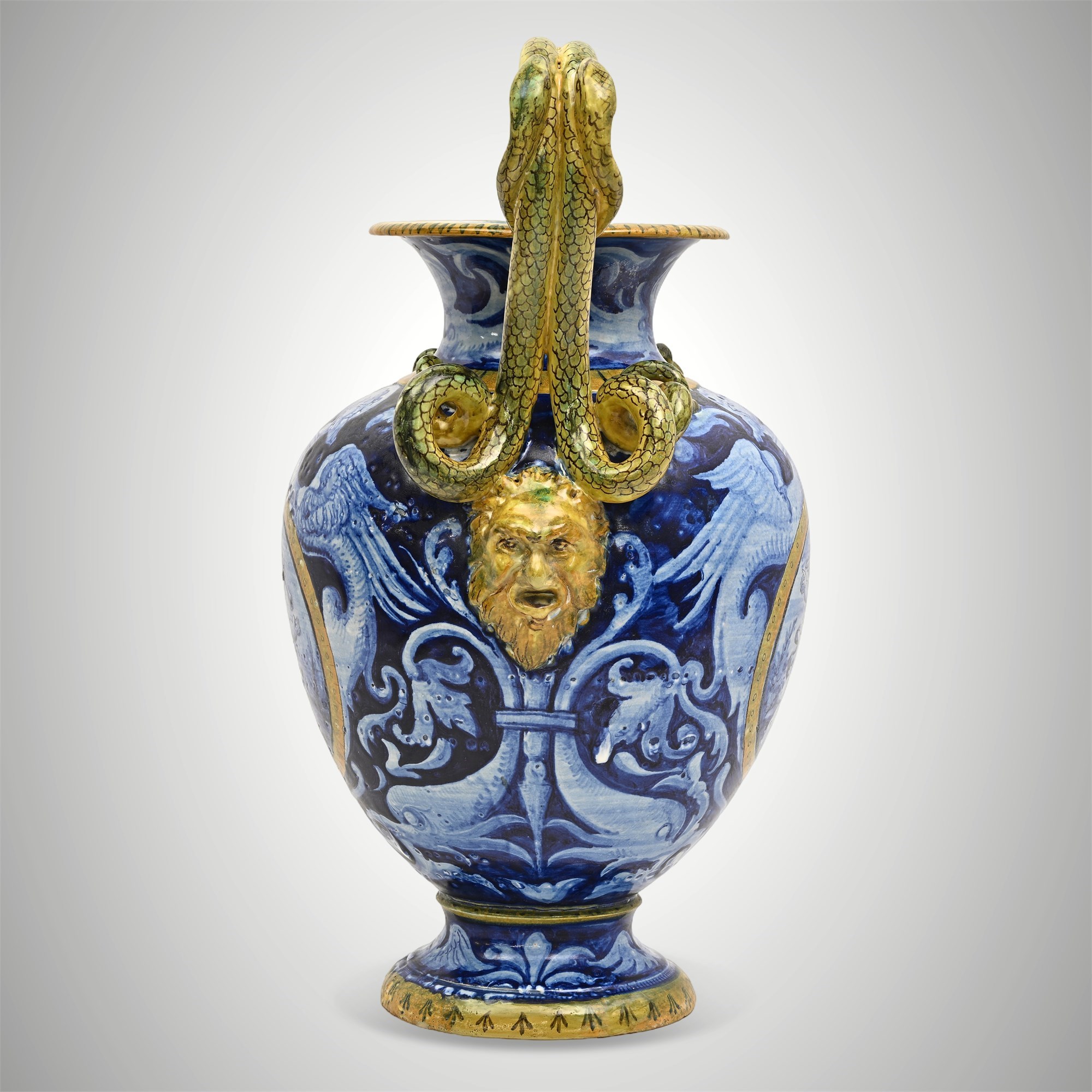
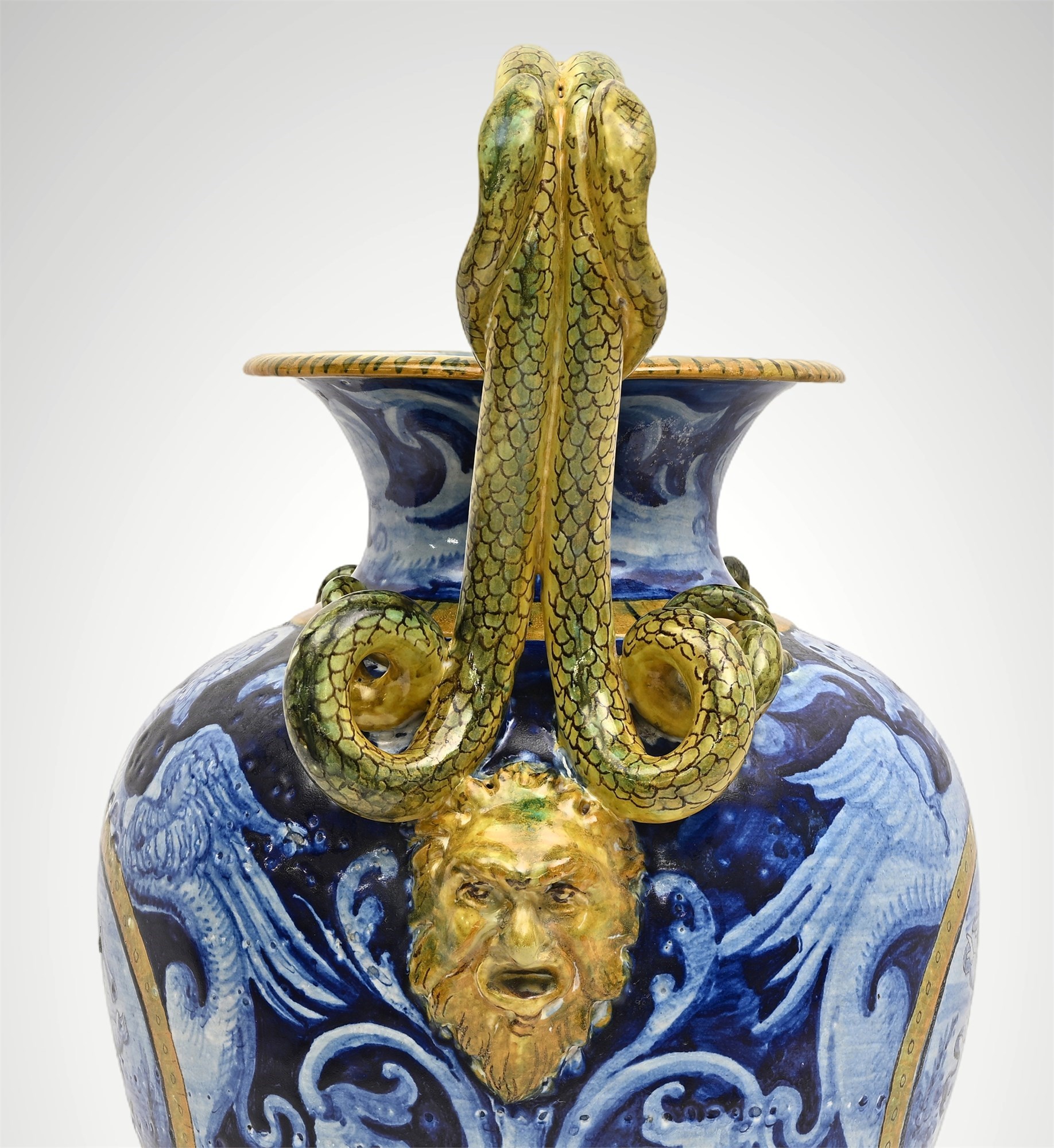
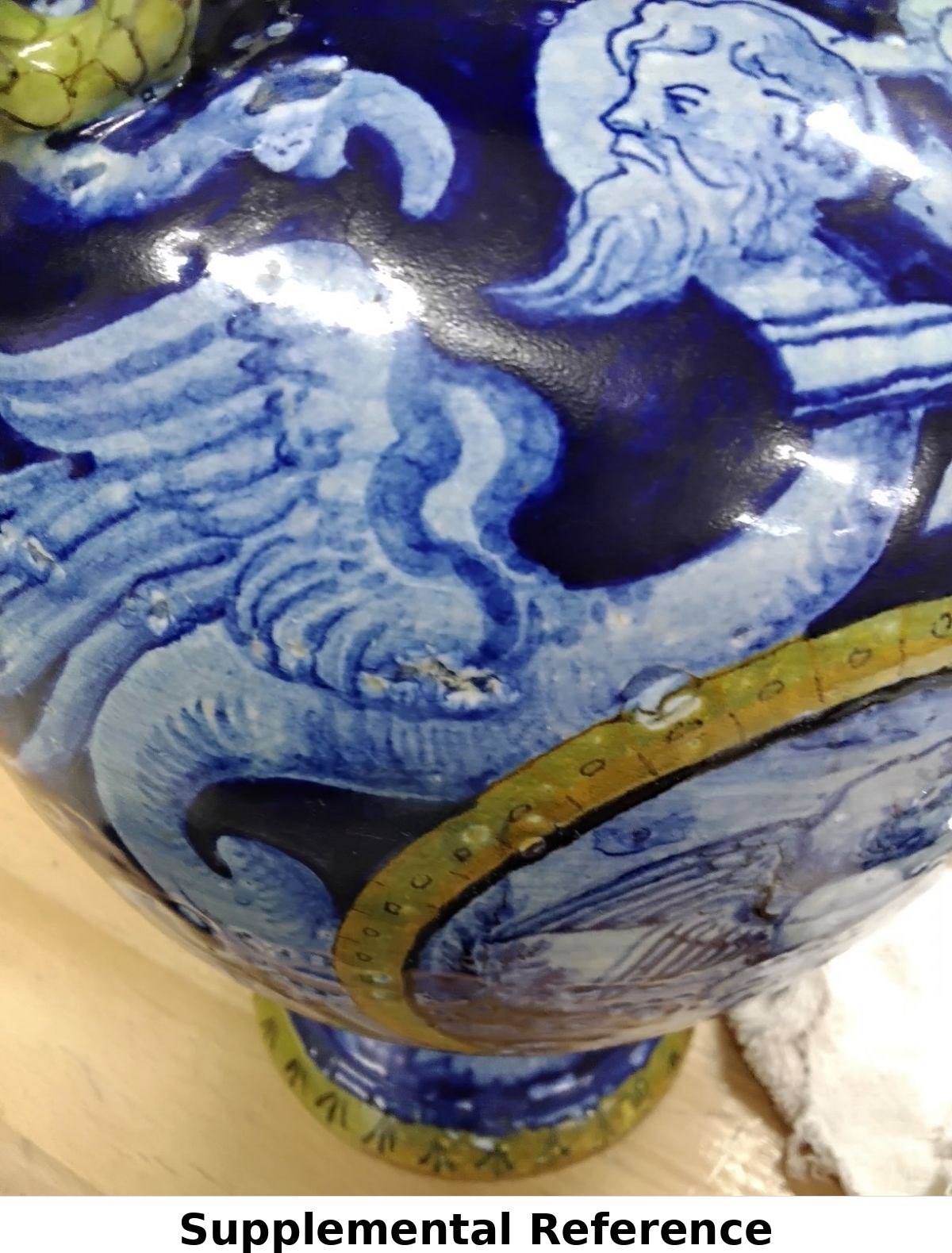
Two serpents coil upward from the shoulders, loop into full rings above the rim, and descend again — each body scaled and glazed in mottled yellow-green, alive with the theatrical naturalism that made Manifattura Cantagalli the dominant voice in Italian Renaissance-revival ceramics during the final decades of the nineteenth century. The serpentine handles attach at the shoulders through applied bearded grotesque masks glazed in amber, their expressions fierce and slightly comic, the whole assembly hand-built and individually finished. Below them, the full body of the amphora carries a dense program of hand-painted and relief-molded decoration: paired bearded winged figures facing each other across a central diamond cartouche at the shoulder, flanked by addorsed sea creatures and acanthus scrollwork in the raffaellesco tradition. At the center of the main face, a circular medallion with yellow-ochre dotted border frames a winged putto blowing a horn — a motif drawn directly from 16th-century Urbino istoriato prototypes. The reverse presents a second figural roundel showing a putto in a landscape, surrounded by seahorse grotesques and a bearded mask below the handle join. The neck carries painted cloud scrolls on deep cobalt; the spreading foot repeats the foliate program and terminates in an ochre band punctuated with arrow-like marks.
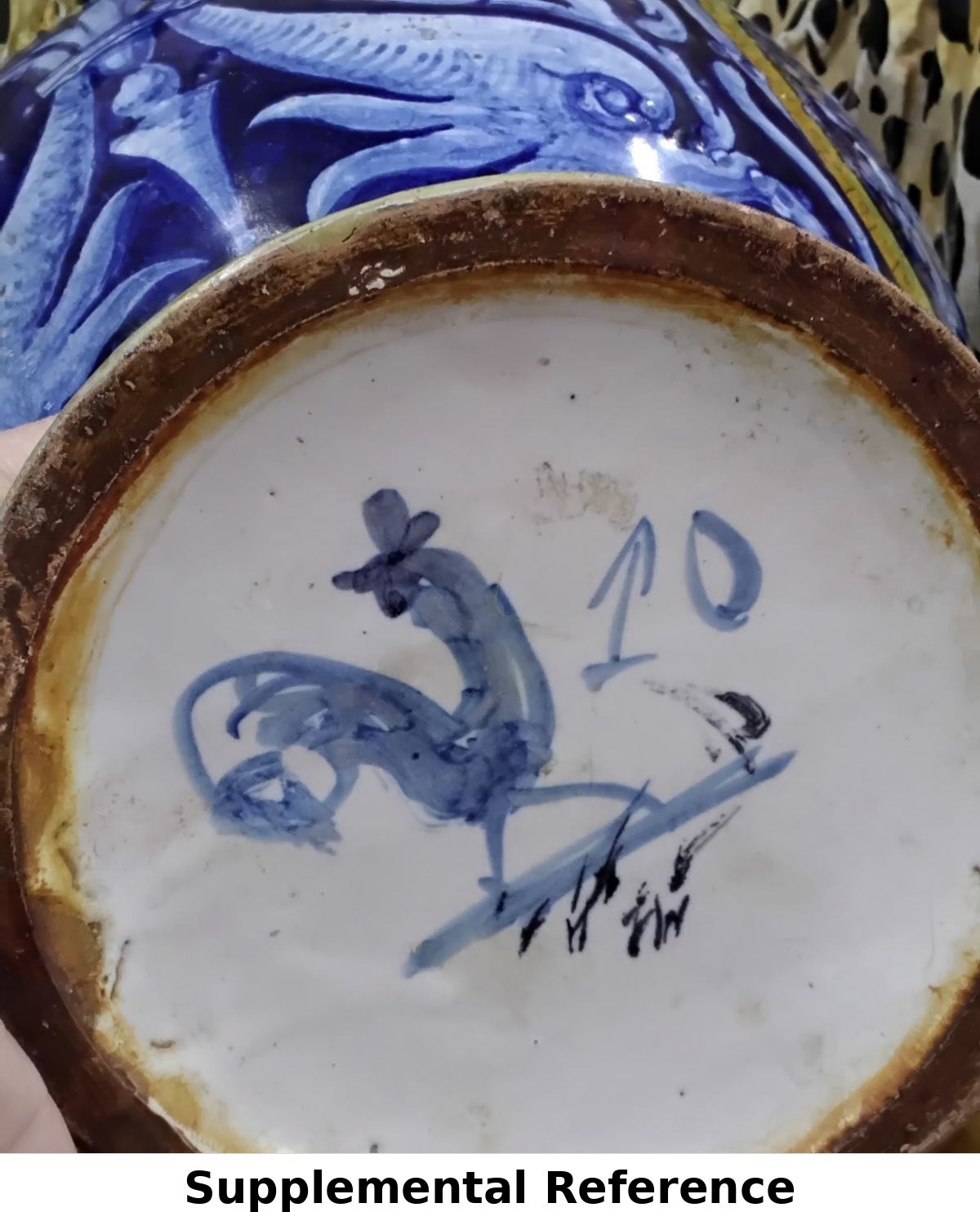
The palette throughout — deep cobalt ground, soft pale-blue relief modeling, warm ochre banding — is characteristic of Cantagalli's finest revival production. The piece is hand-painted, the relief elements hand-applied, and the underside carries the factory's painted blue cockerel mark alongside the numeral "10," consistent with a model or decorator reference number. The overall form — a two-handled baluster amphora on a footed base — draws on ancient Roman and 16th-century Urbino precedents, rendered here with the exuberant plasticity that defined Cantagalli's output for international collectors and exhibition markets.
History
Manifattura Cantagalli was founded in Florence in 1878 by Ulisse Cantagalli, who set out to revive the great traditions of Italian tin-glazed earthenware — Urbino istoriato, Deruta lusterwares, Hispano-Moresque — with the technical rigor and artistic ambition of the original workshops. The factory adopted a painted blue cockerel (gallo) as its mark, a pun on the family name that became one of the most recognized signatures in 19th-century decorative arts. Cantagalli wares were acquired by major European and American museums, exhibited at international expositions, and collected by aristocratic and institutional buyers across the Continent. The factory continued production into the 20th century; pieces from the Ulisse-era workshop, identifiable by the quality of the painting and the modeled plastic work, appear consistently at Christie's, Sotheby's, and Bonhams. The serpent-handle amphora form with grotesque masks and figural roundels is among the most recognizable forms in the Cantagalli repertoire.
Authenticity
The underside carries a hand-painted blue cockerel mark consistent in style and execution with the documented Cantagalli factory mark as recorded in ceramic reference literature and major auction catalogues. The numeral "10" appearing alongside is consistent with a model or painter's reference number as used by the factory. The form, palette, painted decoration, and applied sculptural work are all consistent with authenticated Cantagalli production of the late 19th to early 20th century.
CONDITION
Good. Manufacturing imperfections throughout — glaze pooling, pitting, and minor pinholing consistent with the maiolica process, present in relief recesses and across the cobalt ground. No major damage observed; the serpent handles and all applied grotesque masks are intact and firmly attached.
DIMENSIONS / SPECIFICATIONS
- Overall: 16" H × 11.5" W × 9" D
- Weight: 7 lb 5 oz
- Material: Hand-painted tin-glazed earthenware (maiolica)
- Mark: Painted blue cockerel to underside with numeral "10" — attributed to Manifattura Cantagalli, Florence
- Campbell's Soup Can (4" H) Shown for Scale — Not Included