Ivory & Ebony-Inlaid Dodecagonal Two-Tier Center Table, Late 19th C. View Watchlist >
- Winning Bid: $110.00
- 15 Bid(s) View Bid History
- High Bidder: Melscho
Seller Accepts Credit Cards
Payment and pickup instructions will be available on your invoice (under "My Account") at the conclusion of this auction.
Lot # F791
System ID # 29480994
Start Date
End Date
9 Watching
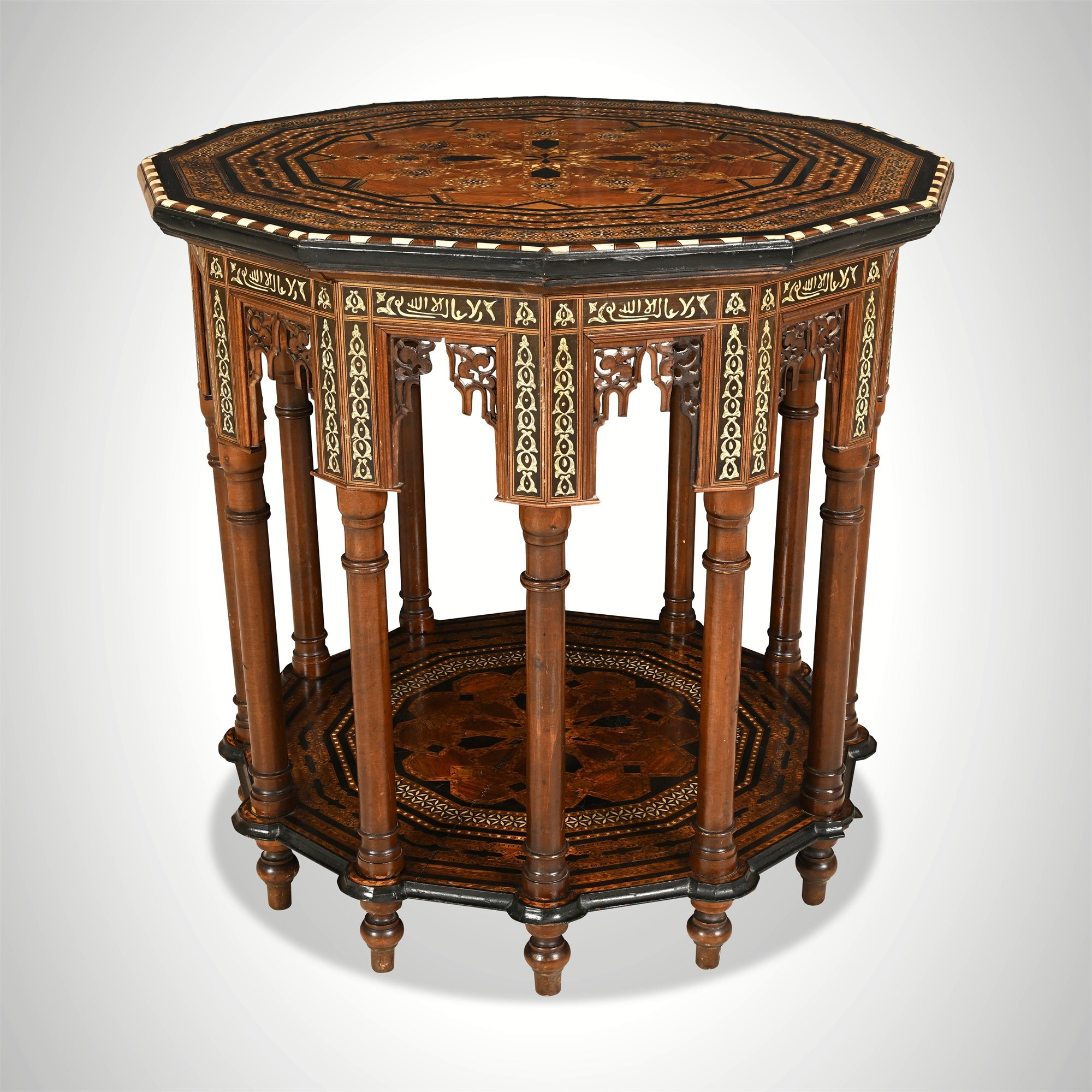
Ivory & Ebony-Inlaid Dodecagonal Two-Tier Center Table, Late 19th C.
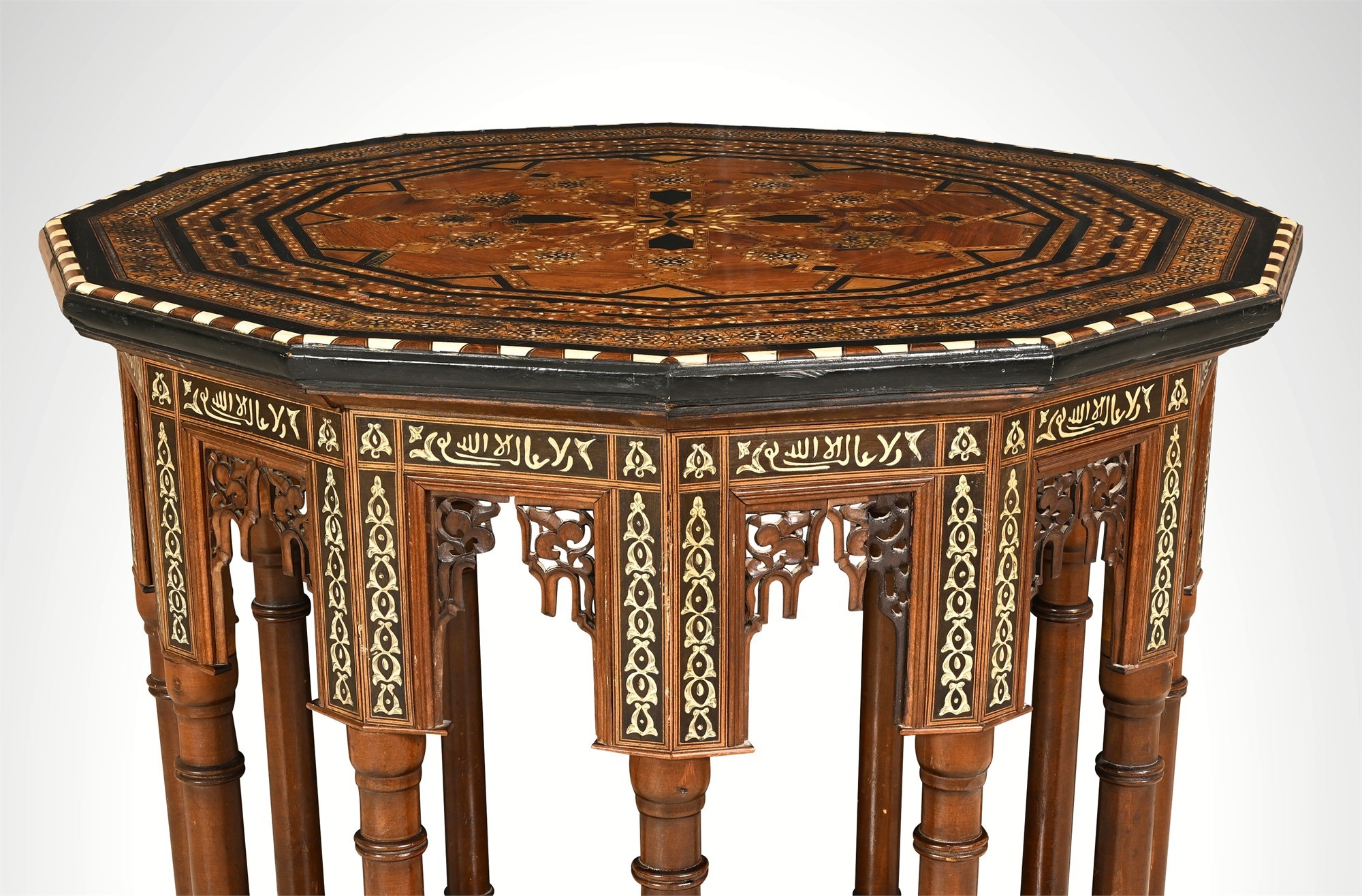
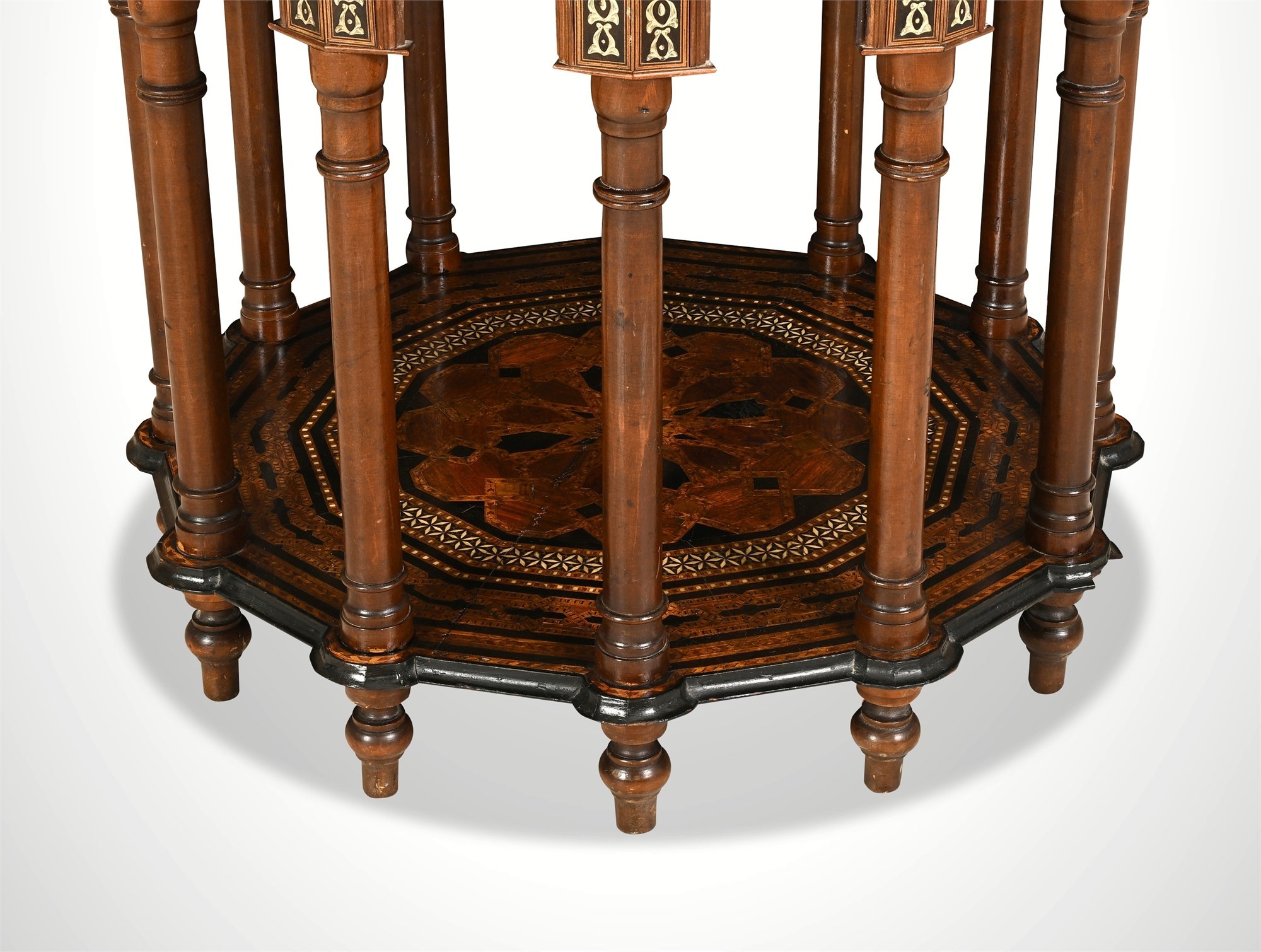
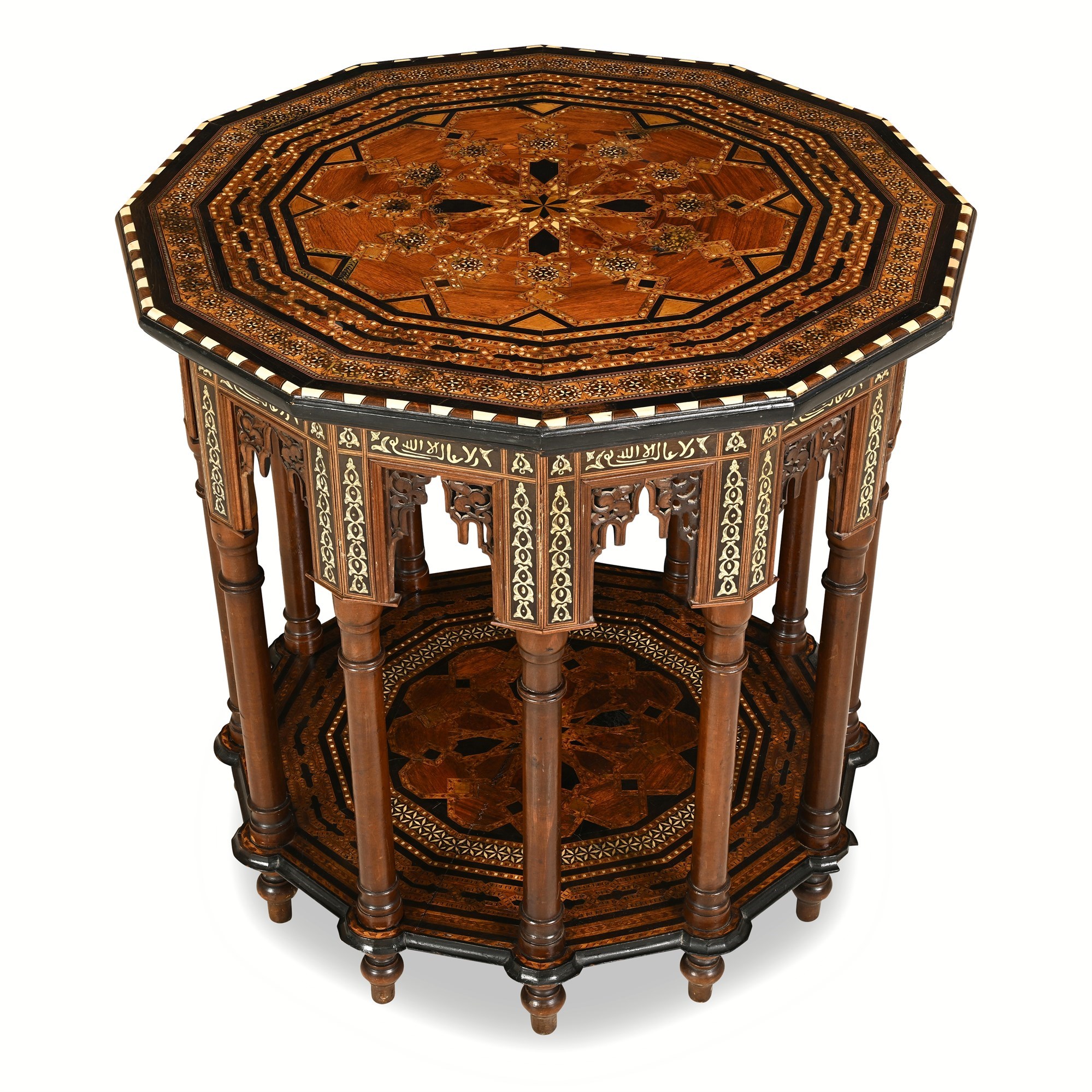
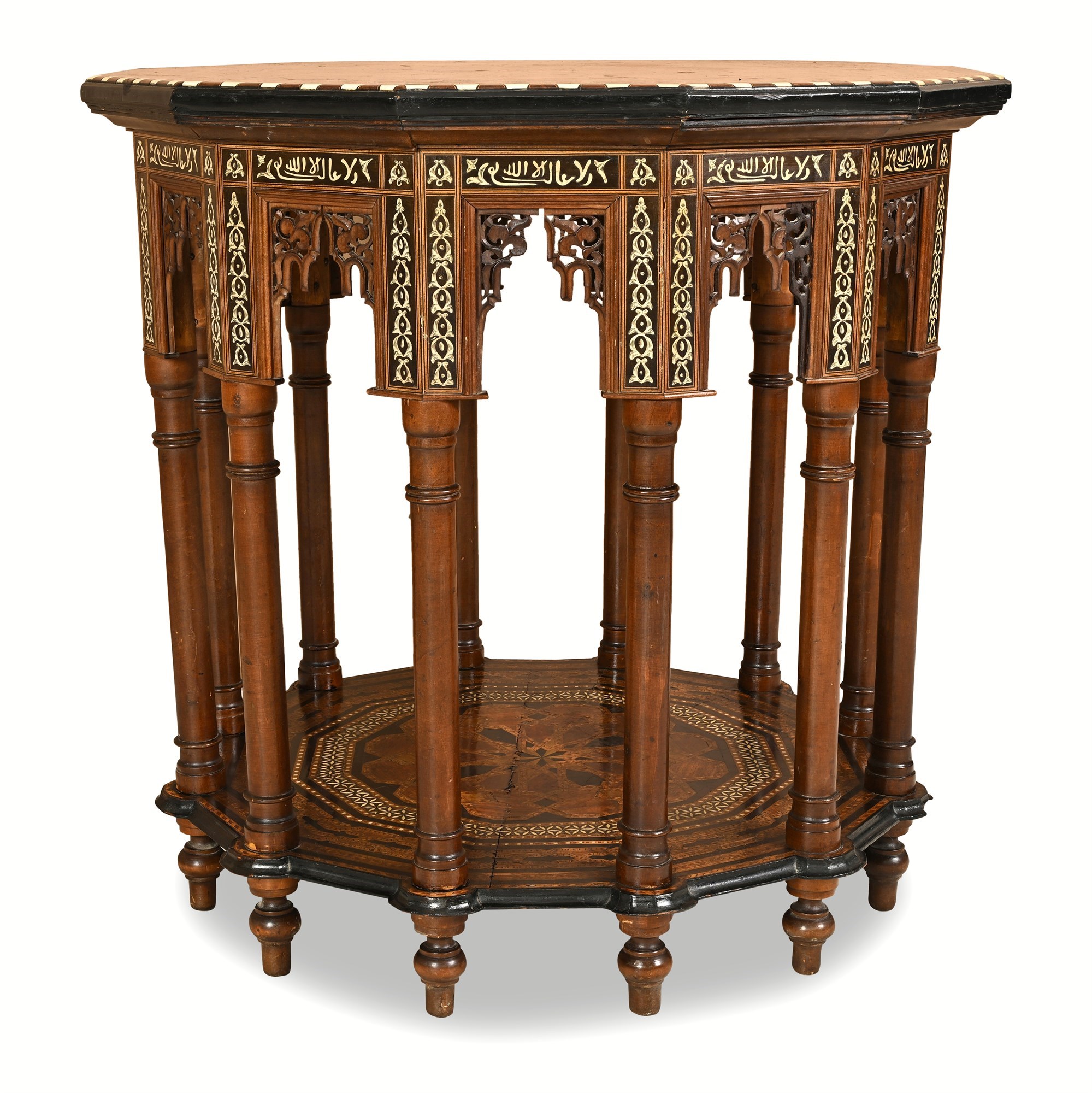
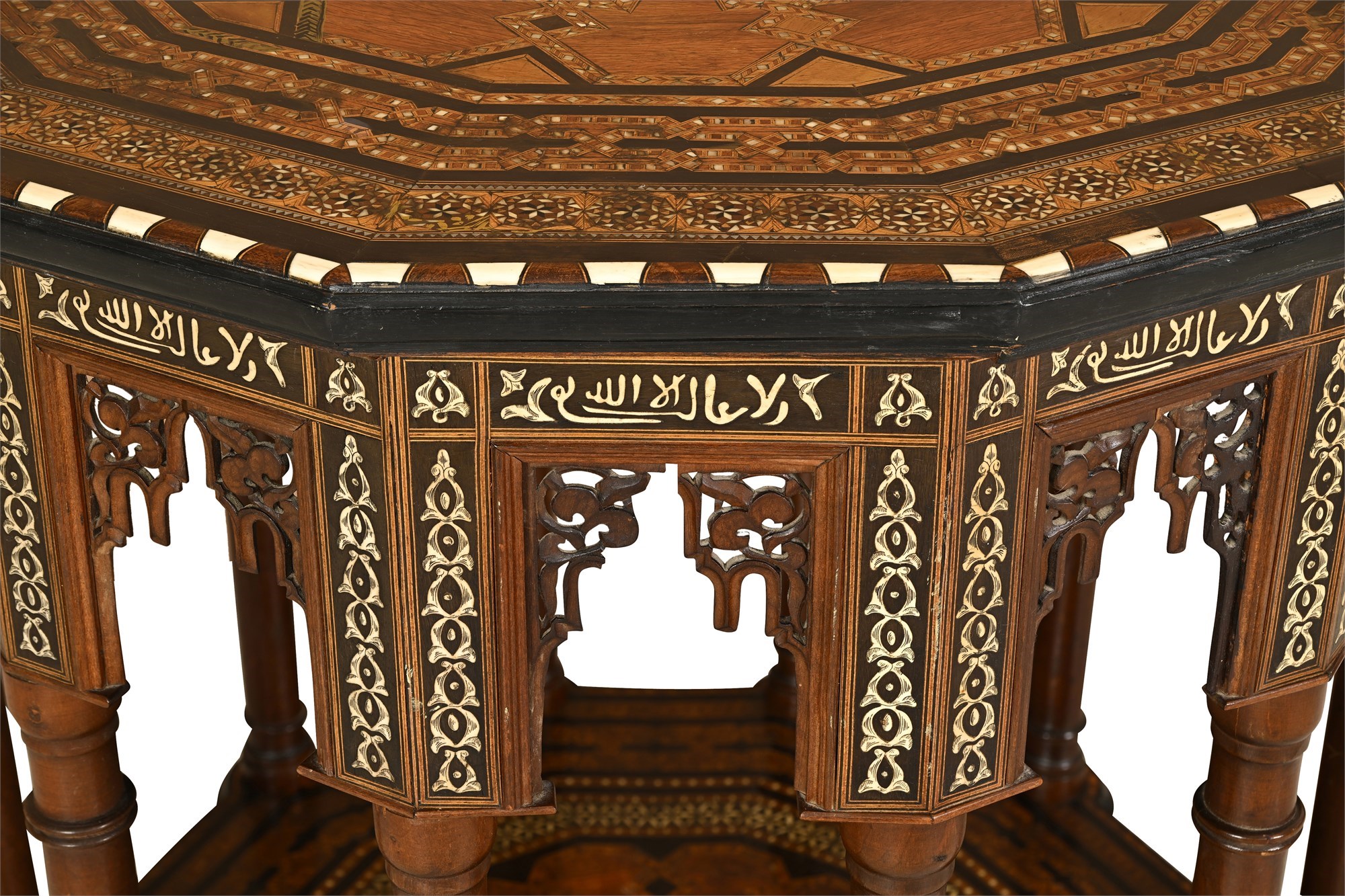
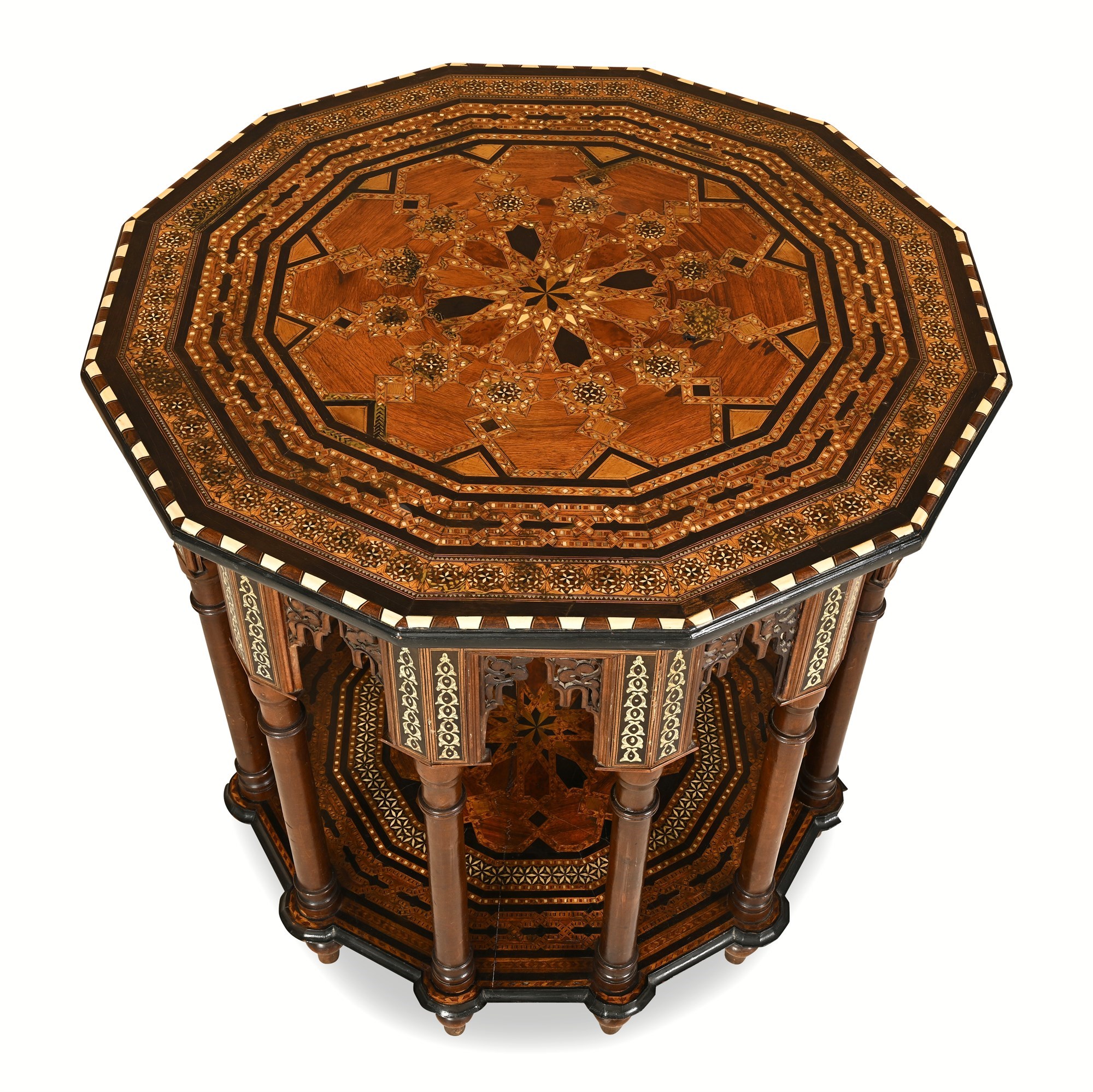
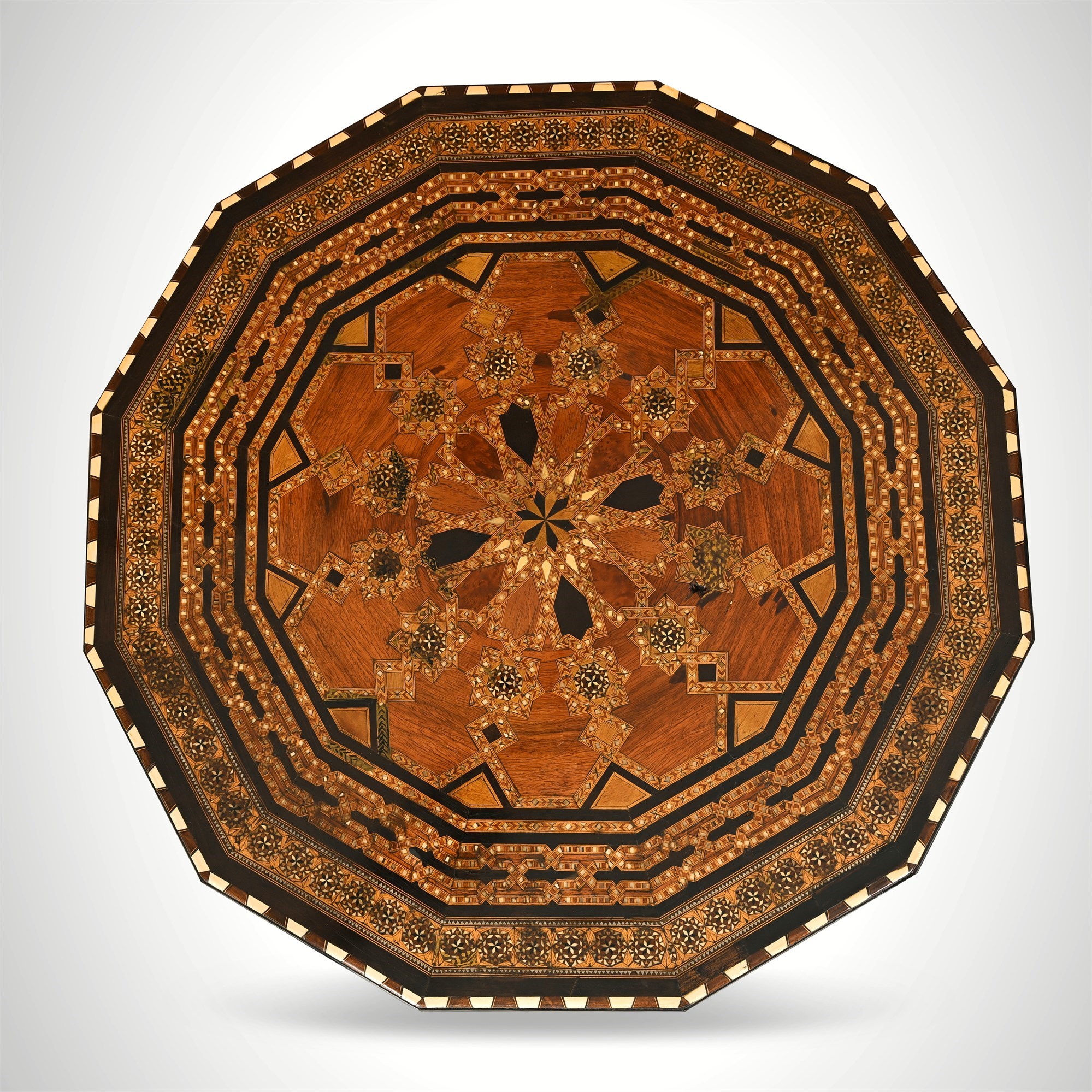
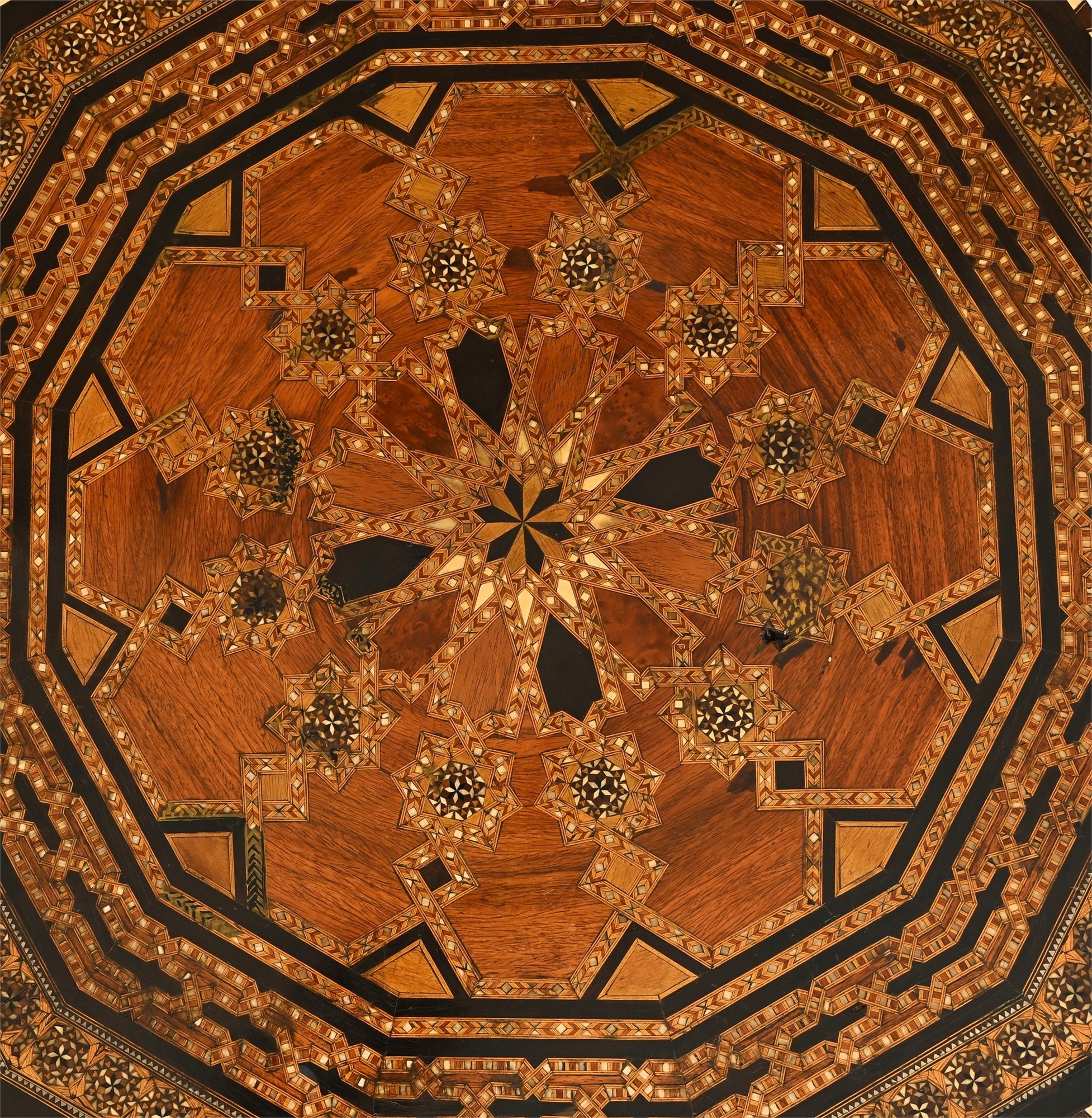
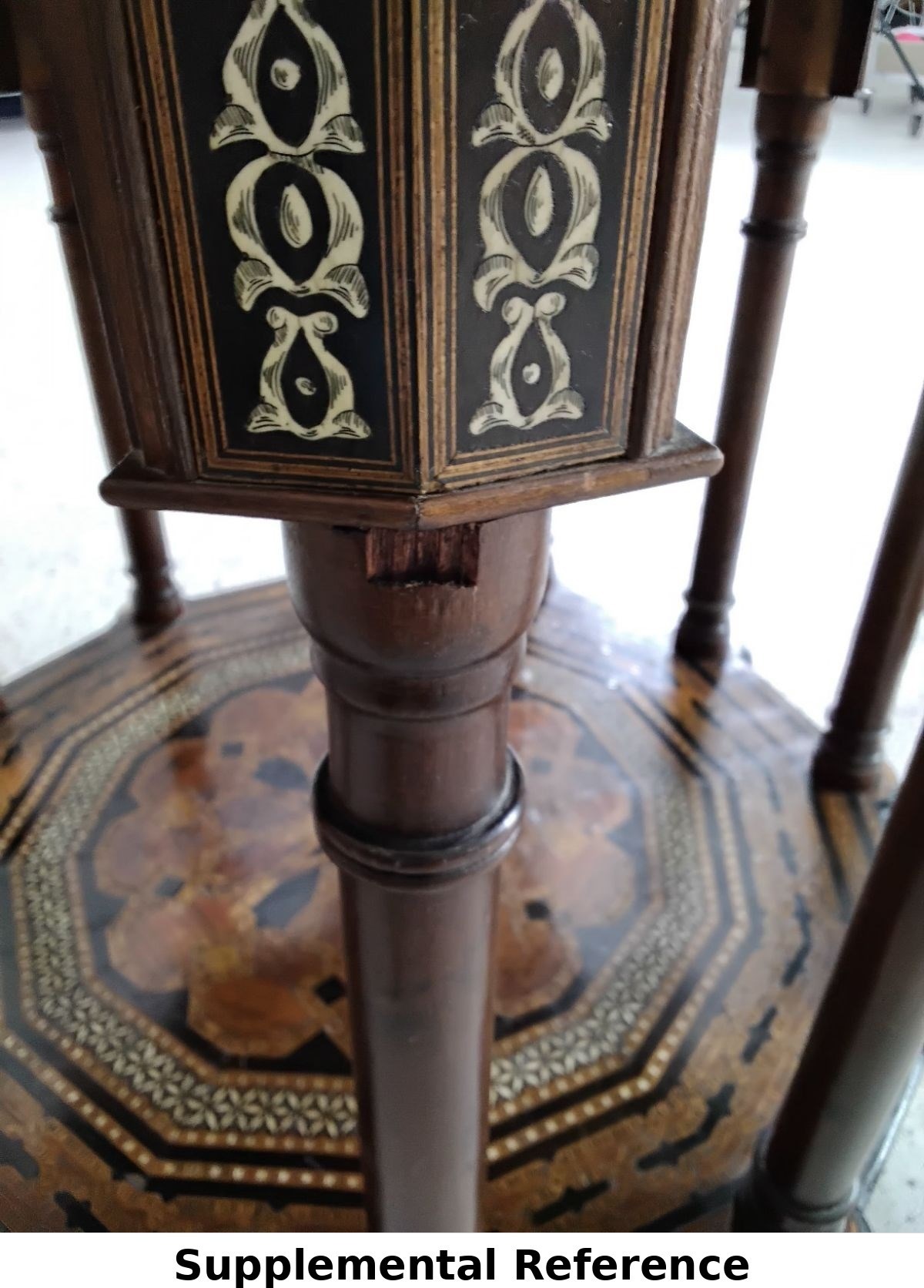
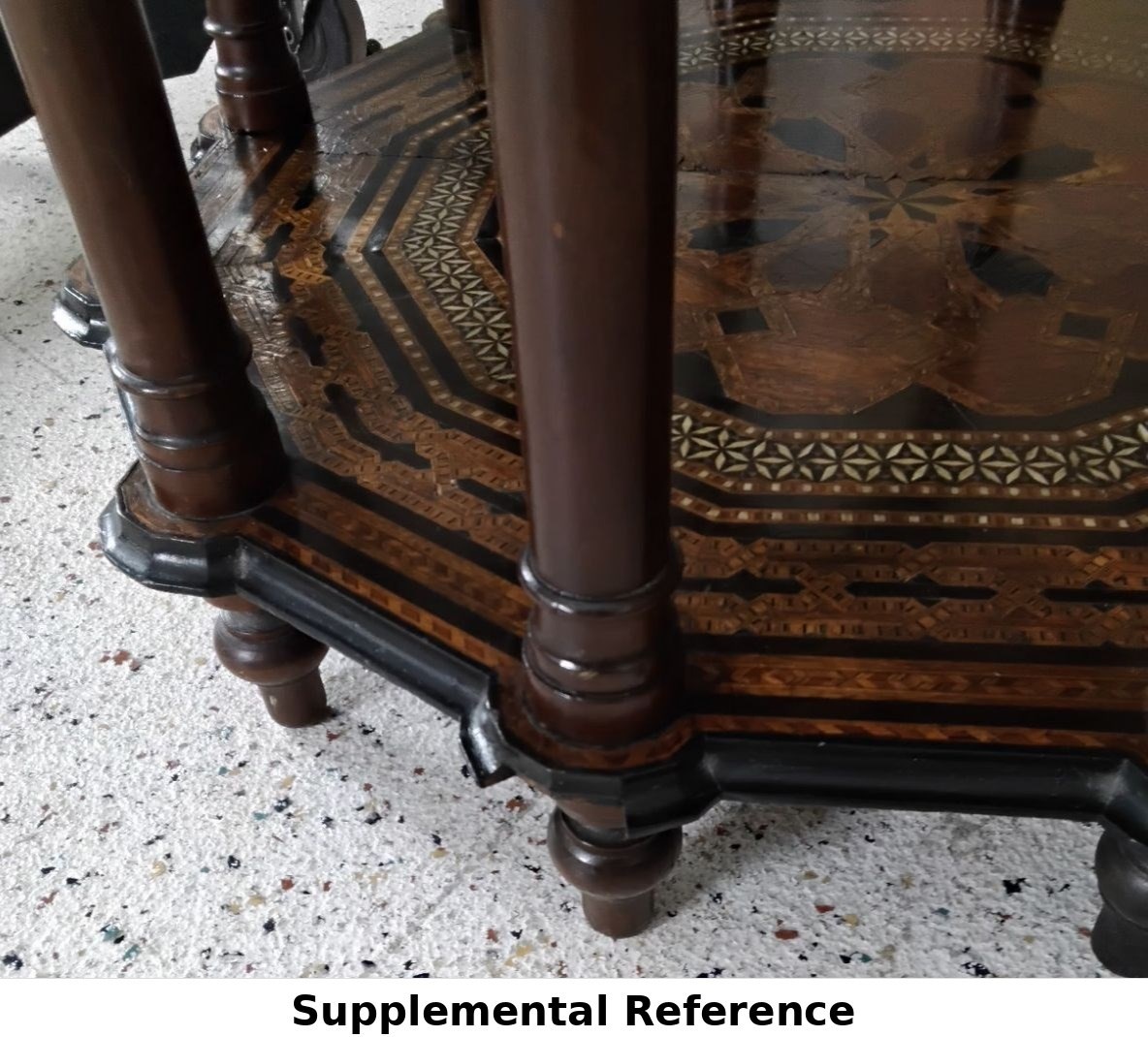
The top of this dodecagonal center table is a complete geometric cosmology in wood and bone: a large central rosette unfurls into interlaced strapwork with dense floral and foliate trailing stems, twelve secondary stellate medallions, and concentric bands of micro-mosaic tessellation, the outermost border edged with chevron bands of alternating camel bone and ebonized wood. The work is dense and deliberate — the kind of surface that rewards time spent with it. Below the top, the frieze carries panels of inlaid calligraphy repeated around all twelve faces — the Arabic phrase lā ghāliba illā Allāh ("There is no victor but God"), the motto of the Nasrid sultans of Granada, rendered here in ivory-toned script on ebonized grounds — each panel framed by scrolling cartouches and divided by pierced, carved horseshoe-arch spandrels referencing the muqarnas of the Alhambra. Turned columnar legs descend through open arcading — the legs ornamented with niched-shaped inlaid panels — to a matching lower tier, itself inlaid with a second radiating mosaic field in the same geometric vocabulary. The whole assembly rests on bun feet within a shaped, ebonized base rail.
Tables of this form were a signature output of the Hoshiarpur workshops of the Punjab, where the firm of L. Khanaya Lal Brij Lal Jain operated as one of the most prominent producers of ivory- and ebony-inlaid furniture for the European export and exhibition market from the 1870s through the early 1900s. Hoshiarpur's craftsmen drew on a deep regional tradition of geometric wood inlay — combining walnut, teak, ivory, and ebony in the same interlaced stellate and calligraphic vocabulary seen here — and their work appeared regularly at international expositions and in the catalogs of major London dealers. The density and precision of the micro-mosaic border work and the quality of the horseshoe-arch spandrel carving on this example are consistent with the firm's higher production grades.
History
Hoshiarpur, in what is now the Punjab state of India, was the acknowledged center of North Indian inlaid furniture production in the second half of the 19th century. When the international exposition circuit created European appetite for objects indexing the Islamic and Mughal architectural traditions, Hoshiarpur workshops — most visibly the house of L. Khanaya Lal Brij Lal Jain — were positioned to supply it. Their tables, chairs, and screens reached London, Paris, and Vienna, and examples entered the collections of the South Kensington Museum (now the V&A) and the Indian Section of the Paris Expositions. The calligraphic frieze on this table carries particular resonance: lā ghāliba illā Allāh — "There is no victor but God" — was the royal motto of the Nasrid dynasty whose patronage built the Alhambra, the same palace whose horseshoe arches and muqarnas stalactites are directly quoted in this table's carved spandrels. The phrase appears on the Alhambra's walls dozens of times. Its presence here, in a Punjab workshop table made for the European market, reflects how deliberately these craftsmen invoked the full weight of the Moorish architectural tradition to meet and exceed European Orientalist expectations. The geometric inlay vocabulary — eight-point stars, interlaced strapwork, concentric tessellation bands, dense floral trailing-stem ornament — derives from the Mughal architectural tradition filtered through the Punjab's own craft lineage. Comparable Hoshiarpur tables attributed to this period and quality level appear regularly at London and New York auction houses; the attribution to L. Khanaya Lal Brij Lal Jain is consistent with the form, ornamental vocabulary, and production period of documented examples.
CONDITION
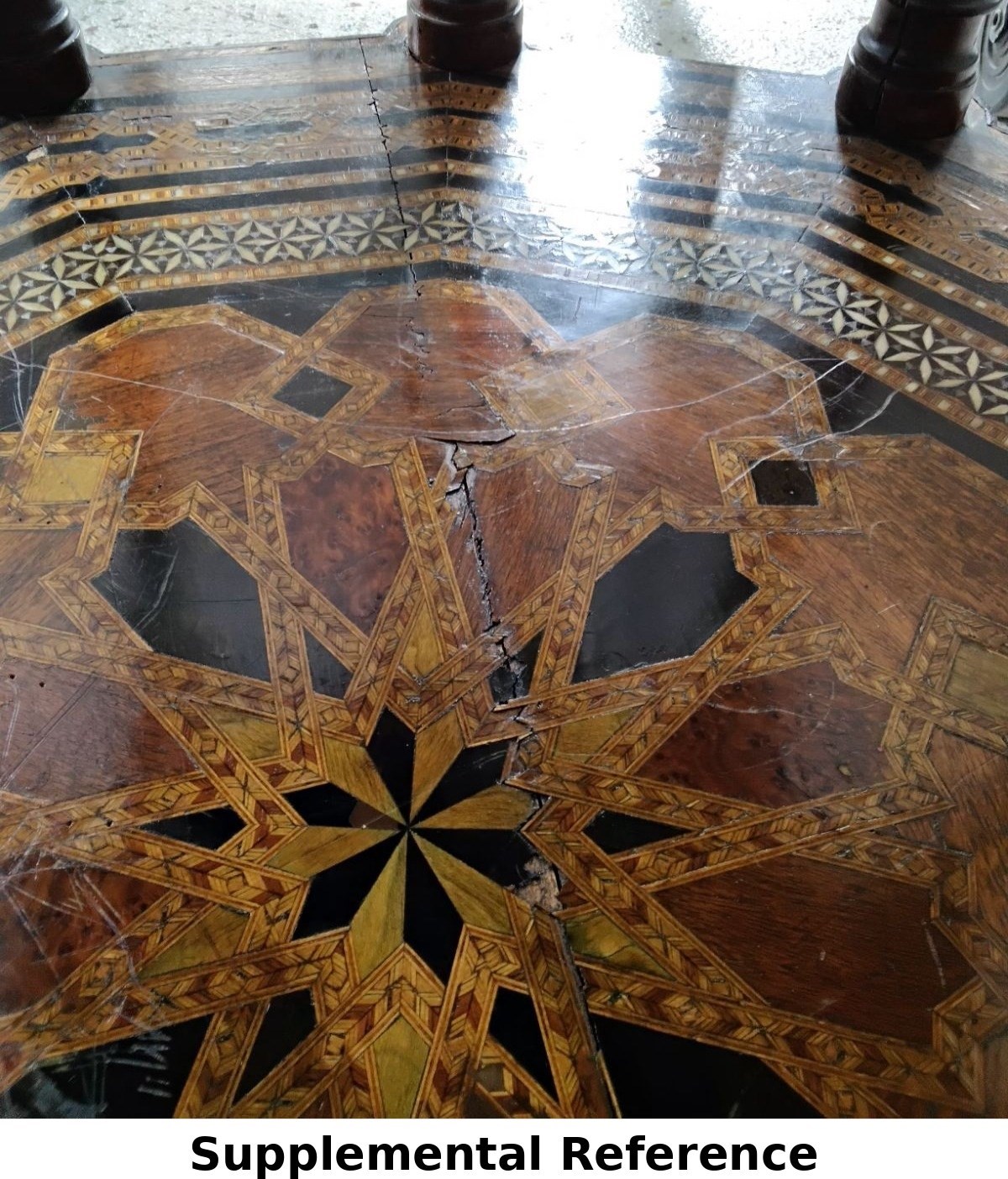
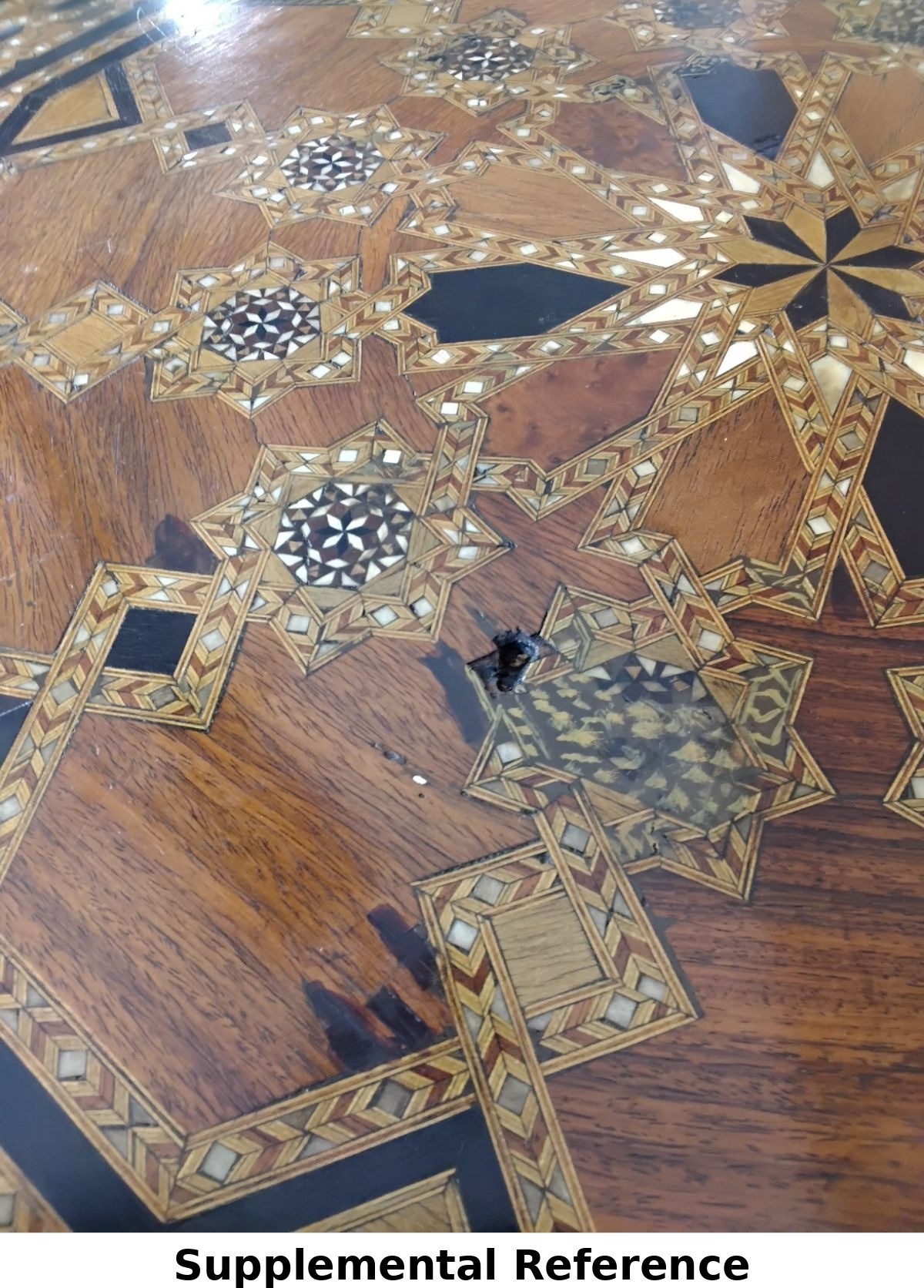
Good overall with age-appropriate wear and signs of use. The upper top surface has a significant radiating crack running from the center toward one edge, with associated lifting and inlay loss along the break line; one star reserve shows a small open void with darkened, deteriorated inlay material. Trim molding is missing near one leg, and one turned support shows a chip at the point where it meets the frieze block. The lower tier surface has its own crack and associated lifting near the center, with scattered surface crazing throughout both tiers. The overall structure is stable and the marquetry and bone inlay are largely intact across the great majority of both surfaces.
DIMENSIONS / SPECIFICATIONS
- Overall: 29" H × 31" W × 31" D
- Form: Dodecagonal (twelve-sided) two-tier center table
- Materials: Solid wood marquetry, ebonized banding, camel bone and ivory-tone inlay
- Origin: Attributed to L. Khanaya Lal Brij Lal Jain, Hoshiarpur, Punjab, Northern India, late 19th century/li>