NASA STS-3 Columbia at White Sands — Original Army Color Photograph, April 1982 View Watchlist >
Seller Accepts Credit Cards
Payment and pickup instructions will be available on your invoice (under "My Account") at the conclusion of this auction.
Pickup
$0.00
($0.00 as additional item)
Signature Confirmed Shipping
$12.90
($12.90 as additional item)
Lot # Nasa89
System ID # 29274886
Start Date
End Date
8 Watching
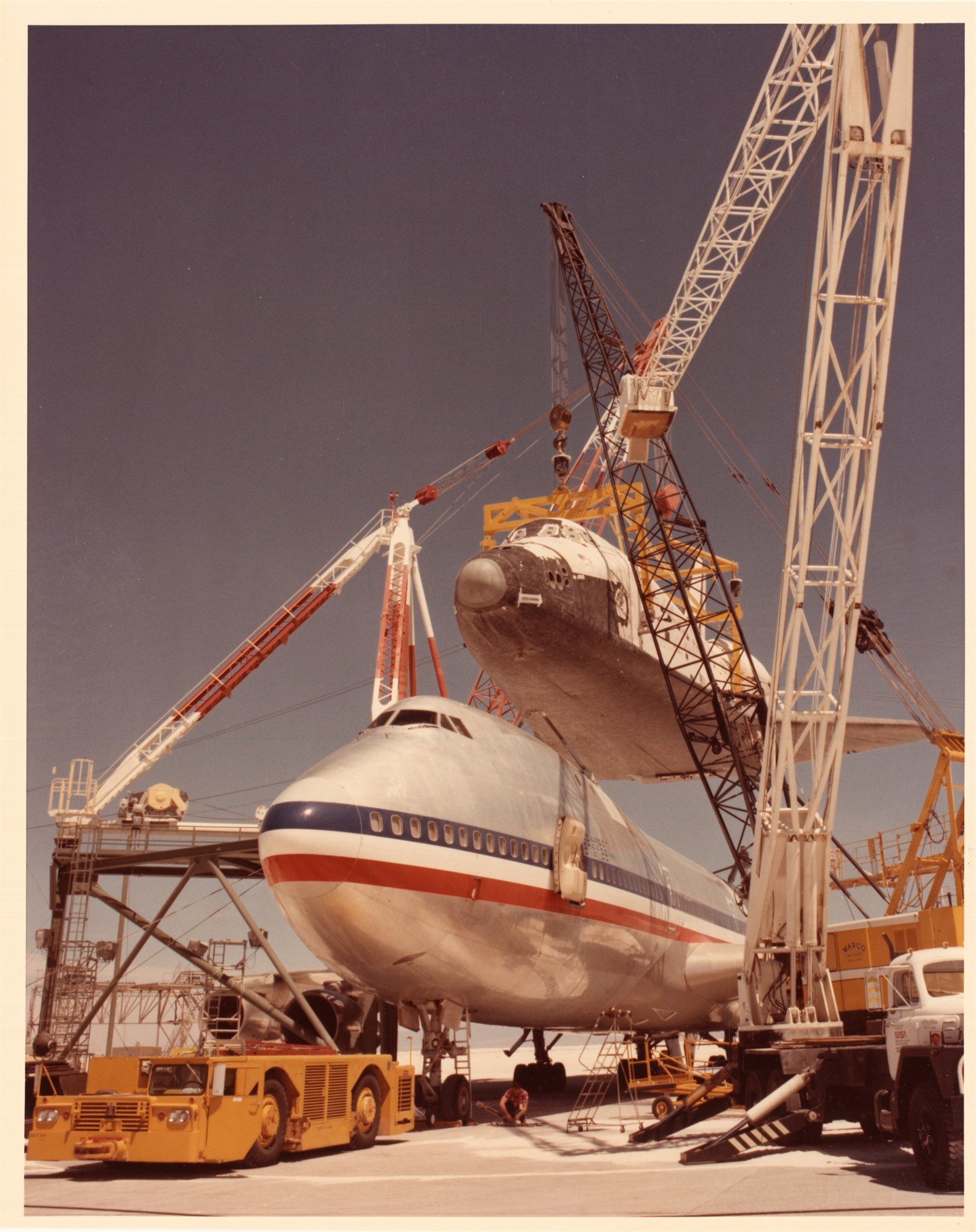
NASA STS-3 Columbia at White Sands — Original Army Color Photograph, c. April 1982
Three heavy-lift cranes — their booms crossing against a cloudless desert sky — hold their positions as a Space Shuttle orbiter is crane-mated to the NASA 747 Shuttle Carrier Aircraft on the tarmac at White Sands Missile Range, New Mexico. The 747 wears its period-correct NASA livery: white fuselage, bold red and blue cheatlines. Tow vehicles and ground support equipment ring the apron below while riggers work the rigging points overhead. It is an image of controlled, monumental effort — the machinery of a space program measured not in orbit but in the quiet logistics of getting the orbiter home.
Printed on Kodak photographic paper — the manufacturer's watermark repeats across the entire verso — this is an original color photograph, not a later reproduction. Army photographers documenting the White Sands recovery and departure operated outside the standard NASA public affairs pipeline, which accounts for the relative scarcity of images produced from their vantage. The White Sands tarmac setting and Army photographic origin are consistent with the STS-3 departure operation, April 6, 1982 — the only time in the Shuttle program's thirty-year run that White Sands served as a primary recovery and departure site.
History
STS-3 (March–April 1982) is the only Space Shuttle mission to have landed at White Sands Space Harbor. Columbia was diverted from Edwards Air Force Base after wet lakebed conditions made that landing impossible; Commander Jack Lousma and Pilot Gordon Fullerton brought the orbiter down on Runway 17 at Northrup Strip on March 30, 1982. High winds had already delayed the landing by one day, extending the mission to just over eight days. Recovery proved difficult: the gypsum surface contaminated tiles, brakes, and ground equipment, and the entire recovery-to-departure operation stretched a full week. On April 6, Columbia lifted off atop Shuttle Carrier Aircraft 905, kicking up clouds of white gypsum dust as it rolled down the strip — one of the most recognizable images of the early Shuttle era. The experience was operationally successful and logistically costly enough that NASA never returned to White Sands for another Shuttle landing.
Significance & Rarity
NASA press photographs from the Shuttle program are plentiful. Army documentation of the White Sands recovery and departure is not. This print's origin outside the NASA photo distribution system — on Kodak paper, bearing no agency stamp or press caption — marks it as an internal record rather than a release photograph. For collectors focused on the Shuttle program, New Mexico space history, or White Sands Missile Range documentation, this represents a genuinely narrow category of surviving material.
CONDITION
Very Good. The print is clean with strong contrast and vivid color saturation characteristic of well-kept Kodak chromogenic paper.
DIMENSIONS / SPECIFICATIONS
- Image Format: Original color photograph
- Paper: Kodak photographic paper (watermark on verso)
- Size: 8½" × 11"
- Verso: Kodak paper watermark only — no caption, stamp, or credit
- Subject: Space Shuttle orbiter crane-mated to NASA 747 SCA, White Sands Missile Range, NM
- Attributed Event: STS-3 departure, White Sands, c. April 6, 1982
- Origin: Army photograph